Category Archives: Uncategorised

Suggestion Saturday: September 18, 2010

Here is this week’s list of blog posts, photos and other tidbits from my favourite corners of the web.

Real Life Tao – Wrestling with a Ghost. How not to be a perfect person. It was something I needed to hear this week.

Personal Philanthropy: Twenty Ways to Improve the World, Even If You’re Broke. What a great concept! Too often philanthropy is only discussed in terms of donating money.

Earlier this week my Dad emailed me these photos. The message at the beginning of the email said they were from the Buffalo Bill Dam on the Shoshoni River near Cody, Wyoming. The creatures: Ibex (or are they Bighorn Sheep? I can’t quite tell.) Click on each photo for a closer look. A discussion about  them can be found at Snopes.com and my brother Aaron found another discussion here.

The flaws we have. It is a novel in three sentences. I never thought I’d reach such a thing!

Autism’s First Child. An eye-opening article about the life of Donald Gray Triplett, the first person to ever be officially diagnosed with autism. His life was and is not what I would have necessarily imagined would be the life of someone with this disorder who lived decades before we understood it. Donald’s story also illustrates just how much of an influence a privileged background has on how people who are different are treated in their communities.

Finally, some food for thought:

Reasoning will never make a man correct an ill opinion which by reasoning he never acquired. — Jonathan Swift, “Letter to a Clergyman”

What have you been reading?

8 Comments

Filed under Uncategorised

You’re So Brave!

New friends sometimes say, “you’re so brave!” or “I couldn’t live without cheese!” when they learn about my dairy allergy.

I wasn’t always allergic. Until adolescence I ate just about anything and it has only been in the last half-dozen years that my allergy became more serious. It isn’t life-threatening but neither it is something with which I can mess around. Reading ingredient lists and not taking risks on potentially safe foods is my normal. I even take these steps when I dream about eating food;on the rare occasions that Dream-Lydia doesn’t take these precautions, a nightmare about my allergic reaction ensues and I jerk awake heart pounding, touching my lips to see how swollen they are before I realize that none of it actually happened.

When someone says these things I think what they really mean is I can’t imagine living that way. That is, they don’t know what it’s like to ponder cross-contamination issues or to recall all of the sneaky places that milk products or other allergens hide when you’re eating at a buffet restaurant or a potluck.  I’ve had similar thoughts about people with other medical or social differences, to be honest, but what I’ve learned is that courage has nothing to do with how one thinks they might react if there’s a seismic shift in what their bodies need or can handle. There’s only what needs to be done today to stay healthy or what substitutions to make or alternate routes one can take for the best quality of life. Normal isn’t a list of little boxes to check off or a line drawn in the sand between those who have it and everyone else.

It’s just life.

4 Comments

Filed under Uncategorised

Poverty Museum

I recently re-visited our local natural and world history museum and was struck by what narrow slices of history were up for public viewing. Imagine if our society was only shown through the homes and possessions of  movie stars and high-ranking government officials a thousand years from now. The picture it would paint of life in 2010, while elegant, would be miles away from how the vast majority of people ever lived. I think many museums are suffering from a similar problem. In every gallery or display, especially within European history, the artifacts presented are almost without fail items that would only be found in the homes of the rich or powerful (or within the four walls of a church or other religious institute.)

Part of the reason for this, of course, is that poor people don’t leave much behind.  Until just a few generations ago almost everyone owned very few material possessions and what they did own was generally used until it was worn out. A coat or chair or pair of shoes that belonged to someone who only owned the one of them is probably not going to preserved for hundreds of years and eventually end up in the possession of a museum. Keeping something safe for all of that time requires money and a fair amount of social/political stability (or a very good hiding spot.) A wealthy family or community is much more likely to access these privileges.

Institutionalized racism, sexism and classism explains another chunk of it. If the ideas and work of wealthy white men is what is valued most in a society then it would make perfect sense for more of their work to survive or even be created in the first place. A slave, a woman who gives birth every other year until  menopause, someone who works six or seven days a week, 12 hours a day in a factory is going to spend much more time trying to survive and what they do create is less likely to be recognized as something extraordinary. Some level of discrimination will probably always be with us but it is becoming much less acceptable to display open prejudice against many groups. It just hasn’t yet really filtered down to how it is we represent our history or traditions in most cases.

Still, it would be so compelling to visit a museum and see gallery upon gallery that showed what life was like for slaves, women, ethnic or religious minorities, the poor, and people with disabilities in various times and places. What did they eat and drink? What did their homes (or institutions, in certain times and places) look like? What sort of clothing did they wear? How did they worship their god(s)? Were they able to access some sort of formal education? How was their career path or vocation determined? What sort of medical care was available to them? How many of their children could be expected to reach adulthood? What happened to their bodies after death?

I am on a wait list at the local library for a book about the history of the common (wo)man by Howard Zinn called A People’s History of the United States: 1492-Present. It won’t cover all of eras that interest me but I am definitely looking forward to reading what Zinn has to say on this subject. Hopefully one day a museum will follow in his footsteps!

15 Comments

Filed under Uncategorised

Suggestion Saturday: September 11, 2010

Here is this week’s list of blog posts, comic strips and other tidbits from my favourite corners of the web.


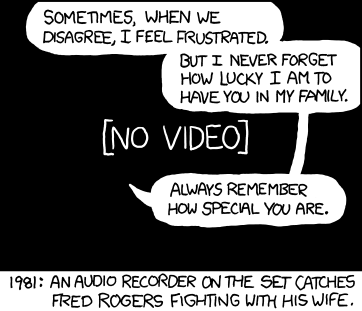
via xkdc. Mr. Rogers is one of my heroes. I wish he was still with us.

The Secret to Forgiving Yourself. Why is it that we’re often so much harder on ourselves than we would be on a friend who made the same mistake?

How to Shrink a City. A Boston Globe article on how cities in the US are coping with – and even embracing –  rapidly shrinking populations. The idea of crops growing next to multi-story apartment buildings in the heart of a city really appeals to me. It seems like it could bring out the best aspects of rural and urban life!

You’re Not Lost So Stop Trying to Find Yourself. Why living in the moment and embracing uncertainty are the only sane options.

Gender and Occupying One’s Own Personal Space. I’ve been trying to do this more and more. It’s hard to break old habits, but the social expectations of how little personal space women are supposed to use in public is fast becoming one of my all-time pet peeves.

What have you been reading?

Leave a Comment

Filed under Uncategorised

Pacifists and Horror Flicks

Despite the title, this isn’t just about watching scary movies or about nonviolence.  It’s about being incongruent.  Yes, I’m a pacifist who loves (certain) horror flicks. Fear and anticipation are a delicious elixir when one knows that they are, without a doubt, absolutely safe. I don’t like blood and gore, torture, or graphic scenes of violence but I love suspense.  The types of horror flicks that interest me, then, tend to be psychological thrillers. I like a little intellectual stimulation and moral ambiguity with my adrenaline. It’s rare to find a horror movie that combines these elements artistically so I don’t watch very many of them.

And yet there’s a part of me that is uncomfortable with this. I don’t always even like to eat meat because  some animal – a cow, a chicken, a pig, a fish, some shrimp, occasionally a deer- had to die in order for me to eat that particular meal. I can’t stand the sight of someone else in pain  in real life, but the threat of it onscreen sometimes is a good thing for a plot. How do I justify these conflicting beliefs? Well, I don’t know that I ever have. I’ll often go a year or so between scary movies because I’m not sure how to, on the one hand, feel just a little guilty for eating meat when I willingly watch movies or TV shows that glorify violent responses to conflict.

The only real defence I can muster of the irregularities in my beliefs and actions in this regard is that stories aren’t real. If someone was actually being chased down the street by a knife-wielding fiend, if the dead really were restless, if aliens actually were on the warpath, I’d protect as many people as possible. Or maybe I’d run and hide with everyone else who doesn’t have super-strenght or a firearm. But I definitely wouldn’t think of it as entertainment in the even most embryonic sense of the term.

So, this is my half-formed thought of the day. What do you think?

Leave a Comment

Filed under Uncategorised

Secular Meditation

Recently I began meditating. I’ve read about Buddhist and other religious-based meditation. I disagree with the vast majority of the religious/philosophical beliefs and assumptions about the human condition but the act of meditation itself resonates to the deepest corners of my consciousness.

Meditation is one of my most effective tools for calming anxiety about things over which I have no control. There’s something about just being in the moment, letting go of the what ifs and if onlys that is so freeing. My natural state is to  analyze everything around me at all times. You may notice me sitting quietly in the corner sipping tea and observing the extroverts among us. Listen closely, though, and one just may hear the whirring of my mind as I compose a poem, wonder how we’d cook, bathe, or keep the floors clean if the house suddenly turned upside-down and everyone had to walk on what had formerly been the ceiling, or ponder the hologram that is our universe.  There’s nothing wrong with any of this – it’s just how I naturally function.

At times it is necessary to turn my thought processes off for a time and live in the moment. Breathe in, breathe out. Nothing in the world exists for that time other than a beating heart, slow breaths.  I’m so new to meditation that I don’t have anything pithy or profound to say about it other than it’s working.

8 Comments

Filed under Uncategorised

Making Worry Work For You

A loved one was hospitalized due to a sudden illness recently. This relative is young and otherwise healthy and we still don’t know exactly why  she became so ill so quickly. It’s not easy to know that someone you care about is suffering and their symptoms are leading the doctors to suspect that they may have a life-threatening disease. (This family member is now home and almost fully recovered from her illness, for which I am unspeakably grateful.)

As we waited for more news, knowing that the act of waiting was all any of us could do, I thought about coping with the fear of the unknown. As odd as this may sound, I like to imagine the worst case scenario and then plan in great detail out how I would handle it.  Sometimes it is just my anxiety talking and I need to stop thinking so much, of course. But at other times I am able to beat back dark thoughts and fear over what may come with thorough planning.

You can’t plan your way to good health for a family member, of course; I will break my traditional Monday, Thursday, Saturday posting schedule tomorrow to talk about handling worry and anxiety when there’s nothing anyone can do to fix a situation.

In the meantime, I’ll pick different examples to explain my thought processes for the remainder of this post; let’s say that I decided to spend a week camping and hiking in the most remote corner of my province possible. Some of the things that could possible go wrong on this trip are:

  1. Inclement weather.
  2. An accidental injury.
  3. Getting lost and spending one or more nights outdoors before we’re able to be rescued.

Even though I know that none of the things are likely to occur I’d still begin making plans to deal with them should the worst happen.

Inclement Weather. In an unexpected severe thunderstorm,  we would probably needs stuff like: sturdy tents, extra food, a way to avoid being struck by lightening or knocked over by strong winds, and maybe something to keep us occupied while we stayed out of the rain. So I’d pick the sturdiest tent we could afford, research the best ways to create safe, strong shelters during bad weather and maybe add a pack of playing cards or a book of short stories to read aloud while we waited for the storm to abate. I’d also keep an eye on the forecast. If severe thunderstorms were forecast during our trip I’d stay home.

An Accidental Injury. If I knew about the trip with enough advance notice, I’d sign up for a first aid class at the local hospital or community centre a month or two before we left. At the very least I’d bring along a travel-size basic first aid kit and brush up on wound care and how best to stabilize someone who had burns, sprains or broken bones until they could access professional medical care.  I may also pack a whistle or other signalling device.

Getting Lost. I’d do several things to reduce the risk of this: packing a GPS or compass and paper map, planning out where we want to go (and what sort of terrain to expect) beforehand and, most importantly, sharing the plan with family members or close friends who lived nearby. If someone knows where we’re going and about what time to expect us back, any rescue team would at least have a good place to start if we don’t come home at the expected time.

Being Stuck Outside Longer Than Expected.If we ended up having to spend an extra night or more outdoors, what would we need? This is highly unlikely to occur  but my contingency plans would still include a basic plan for spending more time outdoors than was originally planned. I’d bring an extra sweater or lightweight blanket for chilly nights, water purification tablets and enough dehydrated food for an additional day or two. If anyone on the trip had prescription medication that needed to be taken regularly, I may suggest that they bring along a little extra as well.

Worrying about something that might happen – or even something that is happening – isn’t as easy to do when I’ve thought it through and done everything I can in advance to prepare for something bad happening. This won’t work in every situation, of course,  but I’ve found that putting a little thought into what I’d do in one potential emergency limbers up my brain in the event that something happens that I hadn’t previously anticipated. And, more likely that not, this hypothetical trip would begin and end without a hitch.

2 Comments

Filed under Uncategorised

Suggestion Saturday: September 4, 2010

Here is this week’s list of blog posts, comics, articles, photos, videos and other tidbits from my favourite corners of the web.

Why Strong Female Characters are Bad for Women.

I think the major problem here is that women were clamoring for “strong female characters,” and male writers misunderstood.  They thought the feminists meant [Strong Female] Characters.  The feminists meant [Strong Characters], Female. So the feminists shouldn’t have said “we want more strong female characters.”  They should have said “we want more WEAK female characters.”  Not “weak” meaning “Damsel in Distress.”  “Weak” meaning “flawed.”

Regrets of the Dying. A must-read top 5 list. The last point was my favourite.

What Would a Nerd Wear? I’m one of the least fashion-conscious people in North America. If it fits by any stretch of the imagination I wear what I already own until it falls apart. The author of this blog also wears more dresses in a week than I’ve worn in the last five years. And yet there’s still something intriguing about this outfit.

Randy Travis – On the Other Hand. My Dad sent me a link to this country music song whose shares a title with this blog. I’d never heard the song before, but Randy Travis somehow reminds my ears of childhood. Maybe Dad played some of his other songs around the house?

Fear Not. What does Pascal’s Wager have to do with convincing a small, frightened child that there really isn’t a monster hiding beneath his or her bed? Even more importantly, is fear contagious?

This tickled my funny bone:

Cyanide and Happiness, a daily webcomic
Cyanide & Happiness @ Explosm.net

What have you been reading?

Leave a Comment

Filed under Uncategorised

Pet Your Dog, Not Your Date

There were many things that the school that I attended from the mid 90s to early 00s did well. Sex education was not one of them.  The midwestern community that I lived in was rural, religious and conservative and the powers that be had determined that the best thing they could teach teenagers about sex is how dangerous it was so we wouldn’t have anything to do with it. Even if the curriculum they chose for us had to lie to convince us to remain or to become abstinent.

A few highlights from my adventures in abstinence-only sex education as a young teen:

Pet Your Dog, Not Your Date

This is the workbook page that stands out the most in my memory. The point being, sublimate your erotic energy into strengthening your emotional bonds, not substitute your pet for your significant other. (er, I hope.)

I’ve never actually figured out why this phrase ever saw the light of day. It’s ripe for mis-interpretation and doesn’t address any practical methods for understanding or coming to accept one’s emerging sexuality.

Hole-y Condoms

Holes too tiny to see with the naked eye, they argued, but large enough for the AIDS virus and sperm to sneak through could be found in every condom available for sale. There was a drawing in our textbook of sperm swimming through holes in a condom. Other forms of birth control were mentioned briefly as well, but only to point out their failure rates and the potential side effects of each type of contraception. Even sterilization, we were warned, could fail to prevent a pregnancy. And no form of birth control could protect our hearts.

Men Want Sex, Women Want Romance

(un)Remarkably, at least for that time and place,  the exercises we were to consider virtually always involved the myriad of ways in which a teenage girl could say no to sex with her would-be (male) suitor. Rarely a teenage male protagonist would ponder how to preserve his manliness without having sex with his lady-friend. In either scenario, though, it was assumed that one member of the (always heterosexual) couple yearned for sex from the depths of their loins, the other member of the couple wasn’t ready and that each of them would always assume the same role in that aspect of their relationship.

Here’s the thing: I felt something was wrong from the very beginning of this class and the condom hole mythlead me to assume that everything they said about sex was a lie.Other than the basic physiology of the reproductive organs and a few other simple biological facts, I’ve rejected everything they taught us. Women are not responsible for the sexual urges of other people. Sex is not the only thing men think about. Not everyone grows up to be heterosexual. Having sex has nothing at all to do with whether you’re a decent human being.

I shudder whenever I hear about current middle or high school student being taught about abstinence even though I tend to agree that the majority of teenagers are not emotionally or socially prepared to handle the possibility of pregnancy or a sexually transmitted infection. (Of course, I’ve also known people who were 30, 40, 50 years old and still nowhere near being ready to accept the consequences of their actions, sexual or otherwise.)

To be fair, there are some valuable lessons I learned from my abstinence-only sex education.

  1. Don’t lie. It erodes the trust of others.
  2. Exaggerating, manipulating or massaging the truth is worse than lying because it is so easily passed down to the next generation. This is how urban legends and myths are created.
  3. Stereotypes are as destructive to the people who fit into them as they are to the people who do not.
  4. Prepare for the worst but never assume that it’s the only possible (or most likely) outcome.
  5. Ultimately, each one of us can only be held responsible for what we do or say as individuals. I’m not responsible for your actions or thoughts, you’re equally not responsible for mine.

Leave a Comment

Filed under Uncategorised

Living More With Less

A few weeks ago Teresa from Thoughtful Eating recommended that I read Living More with Less by Doris Janzen Longacre, a book about the connection between social justice and simple living from a Mennonite perspective. This book illustrates a few of the many reasons why if I was ever going to go back to church it would almost certainly be a Mennonite congregation.

Most of the books, articles and blogs I’ve read about simple living are focused on the benefits of those things for us as individuals. There’s nothing wrong with choosing a more frugal lifestyle for personal gain but Longacre’s focus on the often mindless waste of resources in the west and her description of how changing these habits can benefit others as much if not more than it helps us was a breath of fresh air.

My favourite section of the book involved a list of imaginary development problems that were commented upon by people who lived outside of the United States.  Topics ranged from building energy-efficient public transportation to connect small towns across the U.S. to living without disposable goods to using fewer kitchen appliances and less energy when cooking. Their suggestions for these problems showed how difficult it can be to offer realistic solutions for systemic problems in cultures that you know little or nothing about.  Yet people in the west often give similar well-meaning but misguided advice about which seeds to buy or irrigation systems to use when the people who actually live in that society already know that those items or ideas aren’t going to work for their community. I had never thought about this before and it was a section I re-read several times.

The second half of the book contains tips on getting the most out of what we do use whether it is the clothing we wear, the food we eat, the homes we live in or the celebrations we have for weddings and baby showers among other events. These tips ranged from how to use vinegar to get rid of soap scum to how to build your own home in the side of a hill or out of recycled materials.

One of the biggest drawbacks to many the techniques described in this book, though, is that they require a lot of time and skill. Maintaining a vegetable garden, preserving food safely, cooking every meal at home from scratch, sewing your own clothes, building or retrofitting an eco-friendly home out of recycled materials…none of these things are easy to do when one is already working a full-time job elsewhere. This is something that is feasible for families who live in a rural setting and can devote at least one adult to learning and doing all of these activities. It is more difficult, though, for the 79% of Americans who live in urban areas (80% in Canada) or the 61% of  women who work outside of the home. (59% in the US).

I recognize that this is partially a matter of cultural differences between 1980 and 2010 and (to a degree) cities and rural communities. To be fair, the introduction does say:

Approach this book as if it were an invitation to a treasure hunt rather than a summons to a final exam. Doris Longacre has no interest in legalism or works-righteousness.

One of the things I respect the most about Longacrue is that she isn’t dogmatic about the application of every suggestion in this book.  I don’t know if I’m romanticizing the Mennonite community or if I have just happened to continuously  meet people from that background who approach even their most strongly held convictions with humility and grace but this is something that I deeply admire about them.

I do wish, though, that one of Longacres descendants would write a sequel to this book that addresses the societal shifts of the last generation or two and offered more examples of simple living for the sake of others for everyone outside of the breadwinner dad, stay-at-home mom and several young children model of life. I can only imagine what sort of creative solutions have been hammered out over the last three decades.

7 Comments

Filed under Uncategorised