Suggestion Saturday: January 1, 2011

Happy New Year! Here is this week’s list of blog posts, videos, quotes and other tidbits from my favourite corners of the web. It is a little shorter than usual because there will be a second post showing up here later on this morning.

What if the Earth Had Rings Like Saturn? Sadly if our planet had rings we probably wouldn’t have a moon.

Worthless Food. Do you know which foods are nutritionally worthless? I couldn’t help but think of my mom, a nurse, when I first stumbled across this post. It sounds like something she would say if one of us asked her about good nutrition.

Stephen Fry on the Catholic Church. Fry seems like someone I’d like to meet. I don’t agree with everything he has to say about the Catholic church (or religion in general) but I do appreciate the ways in which he communicates his dis-satisfaction with the institution.

The Art of War:

If we do not wish to fight, we can prevent the enemy from engaging us even though the lines of our encampment be merely traced out on the ground. All we need do is to throw something odd and unaccountable in his way.
I will end this post with a quote from my friend Timothy Jobst:
A thought is just that; they come and go. You should be able to share any thought you might have, bar none. And receive them as well. They are innocuous and harmless. It is our belief and clinginess to them that makes our minds volatile, argumentative and disallowing. Share your thoughts with me anytime.

What have you been reading?

4 Comments

Filed under Uncategorised

What if You Are Wrong?

Commander Locke: Damnit, Morpheus, not everyone believes what you believe.
Morpheus: My beliefs don’t require them to.
The Matrix Reloaded


Here’s something to consider as we slip through last few days of 2010:

What if you are wrong?

What if your most strongly held beliefs or codes – religious, political, philosophical, ethical, moral – are false?

This is a question to which I return from time to time not because I seriously doubt my own beliefs but because there is always the possibility that I could be mistaken. In the past I have been known to switch opinions on a variety of topics after thoughtfully considering new ideas. It isn’t something I expect to happen again but I also never thought it would occur in the first place.

Everything that I’ve experienced so far has led to my current beliefs but I’m not omniscient. Religiously speaking, for example, there could be something that I’ve missed that obviously points to the:

  • Muslims
  • Christians
  • Neopagans
  • Atheists
  • Buddhists
  • Hindus
  • Jews
  • Taoists
  • Sikhs

having the corner on the truth.

Ultimately it is as important to know what one believes and why we believe it as it is to hold those convictions with a gentle reminder that I, you, we could be wrong.

My Rule of Thumb:

If someone cannot admit that there’s a possibility, as slim as it may be, that they don’t have the unadulterated truth I will take everything they say from that moment on with a few teaspoons of salt. One blind spot has already been uncovered. Of how many others are they also unaware?

There is a deep, quiet strength in ambiguity-flecked beliefs, in following hunches, assumptions or even convictions without the zeal of absolutism. Grey is not always a cobbled road between the black and white villages of truth and fairy stories; sometimes it is its own destination.


9 Comments

Filed under Uncategorised

What the Quiet People Are Thinking

Talkative folks, have you ever wondered what the quiet people in your social group are thinking? I can’t climb inside the minds of your friends but I can tell you what I’m thinking about at social gatherings as someone who is quiet in real life.

Sometimes I have nothing to say. This isn’t a negative thing. My mind simply doesn’t always have things to add to the conversation so I soak up what everyone else is discussing instead. I’m lucky to have a few friends who are amazing story-tellers in person or online and I could sit and listen to them (or read their sites) for hours without once uttering a peep.

I’m watching everyone’s body language. How you say something is much more important than what you’re actually saying. One can learn a lot about someone by how they move, sit and interact with everyone else.

Loquacious friends are awesome. I have friends who can talk a mile a minute and I love that about them. Every so often one of them will ask if their boisterous ways overwhelm me. Normally they don’t. If I hang out with someone it’s because we click. It is also riveting to hang out with people on the opposite side of the introvert/extrovert spectrum. We see the world in radically different ways and as cliched as this is going to sound there is definitely something to be said for embracing this and learning from one another.

I don’t have an opinion yet. If everyone is discussing, say, their favourite variety of sea cucumber or various theological interpretations of a particular bible verse I’m probably not going to jump into the middle of the debate.

You learn about others by listening to their stories. There’s nothing wrong with talking, of course, but if I want to get to know a new friend better it is best done by listening to what they say, how they say it and what they leave unsaid.

Rarely I’m quiet because someone has just put his or her foot in their mouth. I know that I’ve cringed over something I said that came out entirely wrong more than once. What was meant to be a lighthearted observation sometimes falls flat. Or maybe it was a question that was taken in entirely the wrong manner. Either way, I’d prefer that others ignore the dumb stuff that slips out of my mouth every so often so I do the same thing for them.

Finally silence isn’t a conversational cockroach. It doesn’t need to be exterminated. In fact, it can add to the conversation more than additional words if what would have been said is inane or repetitive. I’d rather my words mean something than talk just for the sake of exercising my larynx. 🙂

Respond

Fellow quiet people, have I missed anything? Do you disagree with any of my points?

Talkative people, what is your first reaction to a quiet friend at a social gathering? Did anything you read today surprise you?

17 Comments

Filed under Uncategorised

Suggestion Saturday: December 25, 2010

Merry Christmas to those who are celebrating it today and happy <holiday of your choice> to everyone else! Here is this week’s list of blog posts, comic strips, photos, videos and other tidbits from my favourite corners of the web.

How to Make Friends in Brooklyn. We need something like this in every community!

A Candy Quiz from 1945. I wonder how many of these facts apply to candy made in the present day?

How to Discuss Gay Rights. This illustrates why I tend to steer a few thousand miles clear of certain topics until I’ve known someone for a certain amount of time. I can’t say for sure whether this is a good or bad thing. On the one hand I do feel morally obligated to push back against bigotry and ignorance wherever it may sprout. On the other hand there comes a point when people need to take responsibility for their own education on matters in which they don’t have any personal experience. Rake me over the coals for this if you must but I refuse to spoon-feed anyone. 😉

The Twelve Days of Christmas. A Biblical version of this traditional carol.

On Elf Work. A blog post about how gender roles affect what some women do this time of year. It makes me glad I don’t celebrate Christmas or (more importantly!) have a significant other who thinks that gender has anything to do with keeping in touch with extended family. Some people thrive in a relationship with these types of gender roles/expectations but I’m not one of them.

Dixonian Future Animals of Brussels. Here are some absolutely enthralling pictures of hypothetical future animals. I wish I could be around to see how close this models come to the truth in a few million years.

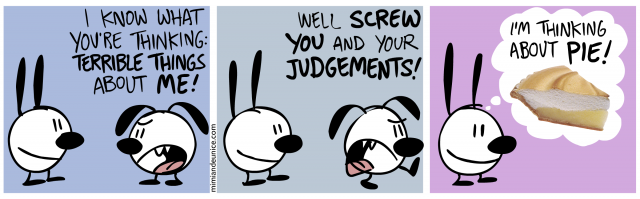
This comic speaks the truth: we will never really know what is going on inside the minds of everyone else and it doesn’t do any good to assume the worst in others. It is something I’ve worked hard to understand in 2010 and will keep gnawing on throughout 2011.

What have you been reading?

Leave a Comment

Filed under Uncategorised

Non-Theistic Morality

“With or without religion, you would have good people doing good things and evil people doing evil things. But for good people to do evil things, that takes religion.”
—  Steven Weinberg

Last week I blogged about a sermon series about the problem of pain and how Bruxy Cavey approaches this question. During his second podcast Bruxy briefly mentioned his beliefs about the origin of human morality. In short, he believes that it comes from God and that there cannot be a just system of morality without God behind it. He says:

Atheists cannot explain their own morality.

While he absolutely agrees that atheists can be just as moral or good as Christians he doesn’t think that this sense of right and wrong can come from a non-theistic worldview:

they [atheists] are far more moral than their worldview accounts for

because he believes that there must be a higher power that arbitrates between various human groups for the greatest good. While I respect Bruxy Cavey immensely as a speaker and as a fellow human being I vehemently disagree with this premise.

For one, religion doesn’t make people more moral or good. The rules – whatever they may be – are broken just as often by the people who believe in them as they are by those who don’t follow that particular religion (or none at all.)

Sometimes, in fact, the act of following the rules actually seems to make good people into much less admirable versions of themselves. I’ve known more than one individual who was a wonderful friend and human being in every way other than his or her religious beliefs. When the topic of God came up it was like a switch had been flipped in that individual’s brain and they lost much of the good that I saw in them the rest of the time. Rather than seeing the rest of us as friends or fellow human beings we became  unrepentant sinners, unbelievers, potential converts or, worse, social projects.

Bruxy and I also have a fundamental disagreement about where our desire to do and be good comes from.

I believe it comes from our generations upon generations of experiences as an extremely social species. With the exception of the rare hermit or mystic we do not do well in a life of solitude. We need one another and so we have learned ways of getting along in difficult situations and of strengthening our bonds with one another.

In short, I believe we (tend to) share similar beliefs about what is fundamentally a good or bad thing to do to someone else because cooperation and altruism are some of our oldest social tools. We could not have survived and become what we are today without them.

In a roundabout way this leads me to today’s question:

What Does Non-Theistic Morality Look Like?

That is, how do people who don’t believe in God decide what is right and wrong? How do we determine what it means to live a good life?

I believe much of it boils down to harm. Do my actions hurt me or someone else, intentionally or unintentionally? If they do I probably shouldn’t be doing them in most situations.

This is a deceptively simple “rule.”  Many aspects of modern business and product marketing  would not pass it because of all of the suffering that is caused when:

  • People are consumers before anything else
  • Workers (especially the working poor) are treated like machines
  • Money is used to define our worth as human beings

My ethical beliefs and morals don’t come with a long list of rules. Almost everything that I puzzle over can be reduced to the question of harm.

I also believe in being and doing good for goodness’ sake! That is, I (try to) lead an ethical life not for any sort of eternal or extrinsic reward but because it’s the right thing to do. Of course I hope that other people will treat me with kindness and respect in return but no one is keeping score here. I’d continue to be as loving, forgiving and kind as possible even if one or several or many people around me were none of these things. (If it continued, though, I’d find a new social group. 😉 )

Respond

What criteria do you use to decide what the most ethical or moral choices are for your life? Why are you good?

4 Comments

Filed under Uncategorised

Exercise for People Who Hate Exercise

Growing up I dreaded gym class. I disliked being told how to exercise or feeling sweaty when I walked to my next class and I really disliked how competitive and repetitive the sports were that we played.

In the sixth grade I had a particularly troubling series of physical education experiences. Between Christmas and the end of the school year I sprained a finger at gym class once or twice each month. No sooner had one finger more or less healed than another would be sprained which meant that I spent four or five months living with at least one swollen, bruised, and resistant-to-being-bent finger almost all of the time. The memories of those months made me less interested in organized athletics than ever before. As an adult, though, I realize that exercising is part of staying healthy.

Some people genuinely enjoy the camaraderie of team sports and  the thrill of competition. Unfortunately I’m not one of them. If I try to keep up with activities that I dread doing I’m not going to have the motivation to continue with them. One of my challenges in 2010 and looking forward to 2011, then, is to find a variety of activities that I enjoy enough to come back to tomorrow, next month, and next year.

Here is my brainstormed list of activities so far. I’ve divided them into two categories: indoor and outdoor.

Indoor

  • Take the stairs instead of waiting for the elevator
  • Walk up or down the escalator
  • Heavy duty cleaning around the house
  • Knead bread, mash potatoes, mix dough, etc. by hand
  • Assist neighbours with heavy lifting or awkward household chores
  • Swim (can be an outdoor activity in the summer)
  • Borrow fitness books from the library
  • Search internet for free workout video clips
  • Free activities: pushups, sit-ups, jumping rope, jumping jacks and squats
  • Cheap(ish) activities: bowling, roller skating

Outdoor

  • Gardening (I hope to have the space for this soon!)
  • Jogging
  • Brisk walks
  • Snow creativity – building snowmen, snow forts, snow monsters.
  • Going on a hike or camping trip (although not during the winter)
  • Bicycling, canoeing, ice skating

Respond

How do you stay active? What non-traditional forms of exercise do you participate in? Can you recommend any other inexpensive, indoor forms of exercise for the winter months? (It’s so much easier to stay active when it’s nice outside!)

14 Comments

Filed under Uncategorised

Suggestion Saturday: December 18, 2010

Here is this week’s list of blog posts, photos, quotes, poetry, comics, videos and other tidbits from my favourite corners of the web. (Photo credit.)

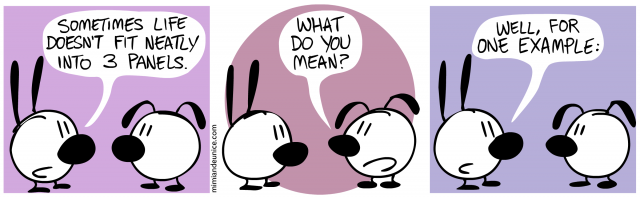
Life In 3 Panels

Glee Meets Dr. Dre. Imagine if a glee club decided to to sing a Dr. Dre rap song. This is not a work-safe video and I don’t recommend it for those who are easily offended by profanity. Everyone else – this is a fantastic example of how reframing a song can expose (and poke fun of) misogyny.

Monticello Slave Chefs. This video discusses how James Hemings, one of Thomas Jefferson’s slaves, earned his freedom by learning how to cook French cuisine at a time  when everything was cooked over an open fire. I’d never realized before how much work it was a few hundred years ago to make even a simple meal!

Life Hacks. My favourite tip was the one that teaches you how to make an elevator zoom straight to your destination. It doesn’t seem like a nice thing to do to those who pressed buttons for other floors, though.

Holding Hands. Ack, I feel emotionally claustrophobic just reading this. 😀

Participating in a Miracle. A new twitter friend, Cathryn (StoryRoute), shares her first experience helping an ewe with a difficult labor. I had previously assumed that only humans had the occasional breech birth.  (The photos do document the birth but none of them are graphic.)

This is Kind of Genius. The problem with being female online. It’s funny because it is too often true (although I have seen an improvement over the last few years…or maybe I’ve just drifted into less sexist social circles?)

A final thought:

Mistakes are a part of being human. Appreciate your mistakes for what they are: precious life lessons that can only be learned the hard way. Unless it’s a fatal mistake, which, at least, others can learn from.

– Al Franken

What have you been reading?

Leave a Comment

Filed under Uncategorised

God and Explaining Suffering

Last month I listened to the podcast of a sermon series about the problem of pain called My God Why? in which head pastor of The Meeting House, Bruxy Cavey, attempts to answer the question:

Why would a loving God allow there to be so much suffering in the world?

Bruxy’s first sermon on this topic boiled down into one sentence:

We can’t know for sure on this side of eternity but take comfort in the knowledge that God suffers alongside us. The links at the beginning of this provide a great deal more detail and nuance to his argument, of course. If you only have time to listen to one podcast in this series I recommend the first one and if you happen to listen to the third instalment, The Origin of Evil, I highly recommend checking out Drew’s response to Bruxy’s theory on the origin of evil. I was actually planning to write a very similar blog post about that part of the series here but Drew nailed every point I had compiled in my head!

What I like about Bruxy’s sermon and the idea of a God who suffers alongside with us:

  • People who are suffering are not blamed for their misfortunes.
  • A suffering God seem more human and far less distant than the other versions of God I’ve been introduced to in the past.
  • Bruxy acknowledges that there will always be a new question behind the one that has just been answered.
  • Bruxy affirms the idea that we see things through a glass dimly on this side of eternity. I appreciate his honesty here.

These are my disagreements or issues with this answer:

  • The idea of a God who suffers with us doesn’t actually alleviate anyone’s suffering.
  • Suffering yourself and allowing someone else to suffer are two completely different actions.
  • If God suffers with us wouldn’t that give him or her even more of an incentive to intervene? I know that I’m far more apt to work to solve a problem if it’s physically or emotionally painful for me.
  • How could a deity who created the entire universe not be able to think of an alternative way to encourage people to worship and embrace him or her that doesn’t involve billions of lifetimes of often unrelenting suffering? Surely he or she could think of something!

To be fair, this is an incredibly difficult question and Bruxy’s answer is best one I’ve ever heard from a theistic point of view. It also avoid many of the often unbelievable offensive assumptions made by or trite phrases embedded in traditional Judeo-Christian responses to this question:

  • God has a plan!
  • Suffering is a divine pop quiz.
  • You’re suffering because of a past un-repented sin.
  • You’re suffering because your parents or grandparents have un-repented sin.
  • If your faith was stronger you and your loved ones wouldn’t have these problems.

Unfortunately something is still lacking in this explanation. Or at least it is for me.

Imagine  if a storyteller began to quietly share a new tale of adventure over a roaring fire late at night. Just as the hero or heroine gasped one last breath before his or her seemingly grisly, unavoidable death the storyteller says “and then somehow it all worked out in the end and everybody lived happily ever after. The end. Who wants another marshmallow?”

Bruxy’s explanation sounds a little like this to me. It begins in one place, veers off in a completely different direction and then ends abruptly. I want to find solace it but it has too many rough edges.

A blog post isn’t enough space to figure this all out, of course. Honestly, a lifetime isn’t even long enough. There are other explanations out there, though, which is the other half of what I’d like to discuss today.

Alternative Explanations

Sh*t happens. You can make all of the right decisions, take every known precaution and still end up being diagnosed with an incurable disease or die in an accident tomorrow. There are no guarantees in this life, no magic elixirs to protect your loved ones from harm. This also means that no one deserves everything that happens to them. Tragedies to triumphs, some things we earn, others are given to us, and others show up out of nowhere. The problem with this explanation is that, at least for me, this  doesn’t provide any hope that tomorrow will be any better.

God doesn’t exist. This isn’t actually something I believe but it does account to a certain degree for the randomness in which fates are doled out. If there’s no one working behind the scenes it makes more sense for selfish, wicked people to prosper as much if not more than those who are kind and giving.

God exists but isn’t involved. At times I do believe this one. One of the benefits of being Agnostic is that I don’t have to claim anything as the capital-T Truth. When I do lean toward the idea that God exists it makes far more sense for God to be uninvolved  in the affairs of his or her creation than it does for God to love us, have both the knowledge of intense suffering and the ability to end it and yet still do nothing to alleviate it. This (apparent?) lack of action is something that disturbs me to the marrow of my bones.

None of this is real. Another theory: we’re living in the matrix. Everything we think we’ve experienced has been a simulation, a computer program of sorts. I’ll admit that it is one of the wackier theories out there but there is a certain allure to it. If nothing else it’s an intriguing metaphor for how we interact with this thing called existence.

What do you think?

13 Comments

Filed under Uncategorised

Suggestion Saturday: December 11, 2010

Here is this week’s list of blog posts, gobs of poetry-related stuff, comics,  photos and other tidbits from my favourite corners of the web.

The Fig Tree. A poem about the self-esteem of a tree. It sounds like the sort of thing I’d write. (Photo credit.)

Mr. Ray. The life and death of a man in Calcutta.The portion I’m linking to is actually the fourth instalment of his story. (There are links to first three sections at the top of the page.)

Even If… Anyone who knows me well would agree that I’m uninterested in traditional romantic stuff. I’d much rather be the recipient (or giver) of everyday, practical whispers of affection instead of flashy, one-time declarations or gestures. Yet I adore this poem.

Be Nice and You’ll Be Rewarded. On catching the most (metaphorical) flies. The first three-quarters of this piece make it sound as if the author advocates being nice so that people will give you free or less expensive stuff. This isn’t what she is actually saying, though. Read a little further on. 🙂

from Written on the Bones:

One thing I might say to someone who can’t relate to poetry is: You don’t have to love all poetry. Do you love all music? Do you love every piece of art you see? Find just one poem you love, and speak it out loud. Your body, feelings, voice, and thoughts will come into harmony when you speak a poem that matters to you, and that can be incredibly healing.

Mesmereyezing Magic Worm. This photo is pure silliness but it did remind me how I’ve never been able to see the hidden images in those technicolored optical illusion photos that were so popular in the 90s. (Yes, the misspelling in this entry is intentional. It’s also a pun which is one of my favourite types of jokes.)

The Dinner Party for Everyone. Now this is a vision of God and the afterlife in which I could believe!

What have you been reading?

2 Comments

Filed under Uncategorised

The Anatomy of Innocence

Before we dive into the meat of this post there are a few stories you should know.

1986. Lake Erie. A study in personalities: my newly-mobile baby brother, Jesse, tries to crawl into the middle of the lake. I stand before the largest body of water I’ve ever seen and ask where the drain is and how and when it will be pulled. I wonder, but do not ask, where the drained water will go, how loud it will gurgle and how long it will take to refill the lake tomorrow morning.

1995. Ohio. I’m 7/10th a little girl. For now. Every Sunday after church I absorb Xena: Warrior Princess in my newly-decorated, mint-green bedroom, still adjusting to these things called cable television and puberty. The ripple of Xena’s muscles as she fights off the bad guys and her connection with Gabrielle nudges something deep inside of me that I won’t noun for years to come.

The Difference Between Men and Women

In the 1990s I heard the same story about sexuality over and over again at church, in abstinence-only sex education classes at public school, and from the mouths of about a dozen different special speakers overtly and covertly at assemblies and special church functions over the years:

As a young woman it is your job to monitor how you dress, act and behave so that men don’t become too distracted around you. Men aren’t like women. They have needs.

Once I heard a speaker, one of the few women who I ever saw speak in front of a large church group, acknowledge that men needed to be careful not to play around with the emotions of women. That, apparently, was our achilles heel.

As a Christian, especially as a Christian who was also female and a preacher’s kid, I wasn’t suppose to think about sex. Even being attracted to other people was morally dubious. I never did figure out how to avoid that.

Not only did I have sexual thoughts and feelings…only some of them were about the opposite sex. In a culture that said gay or lesbian in hushed tones (and bisexual not even once), in a world in which everyone knew that these things were caused by mothers who loved their sons too much and fathers who loved their daughters too little I had a lot of stuff to figure out.

The pieces I’d collected didn’t fit together. I’d always had a father who adored his kids, who would do anything to protect and provide for them and I couldn’t wedge into the sharp corners of straight any more than I could into the term lesbian.

How can I carry your bag when I already have my own?

As each youth group rally, sex ed class and special speaker layered their ideas about gender roles and sexuality on top of one another the question of carrying two bags weighed more and more heavily on my mind. Even before I knew how my puzzle fit together I thought it was insane to ask me – or any other teenage girl –  to assume responsibility for someone else’s sexuality. Carrying our own was work enough. I didn’t know how to carry two and had no interest in trying.

No one else I knew was asking these questions and if they had their own puzzles pieces to sort out I never caught a glimpse of them. In these ways I felt anything but innocent.

Over time, a very long time, I began to sort out the pieces. There was always a part of me that felt worldly for having these tasks, though. It wasn’t that I was ashamed so much as it was that I didn’t know how to reconcile my life. Asking a metric ton of tough questions was one thing. Bisexuality was another. But I didn’t know how either of these could or should intersect with my spirituality.

I know this is a long post. I have one more story for you.

Toronto. 2009. In the middle of a conversation during a big project a coworker turns to me, tilts his head and says “you’re so good, Lydia.” I’d adjectived myself many times before then. Good was one of the slipperiest modifiers of them all. Between my jumbled up puzzle and the Calvinistic undertones of my (former) faith it felt weird as hell to use that word to describe anyone other than God.

What is innocence? What is worldly?

I don’t know any longer. Those aren’t even the right questions to be asking. All I know is that I’m me. You are you. There is nothing else either of us can be.

Leave a Comment

Filed under Uncategorised