The Care and Feeding of Ideas

Every September there is a fantastic book festival here called Word on the Street.  Everyone who values knowledge and the free exchange of ideas belongs there, regardless of age, background or worldview. Imagine a city park filled with booths promoting graphic novels, children’s stories, magazines, literary journals, literacy foundations, religious groups like Muslims and a spattering of neopagan and new age gurus, and even some authors promoting books that I think were self-published.

In the middle of the park one can find poetry and dramatic readings, special speakers on a variety of social and ethical topics, political debates, and Q&A sessions with a wide variety of publishers, authors, and bloggers. Many of the views represented each year are contradictory. It doesn’t matter, though, because this is a festival of curiosity, wonder at the world around us, and the cross-pollination of ideas.

Ideas rot from the inside out if we never test them, share them with others, or listen the views of people who see the world in a different way. It doesn’t matter what the idea is, isolation breeds extremist views that can do much more harm than good.

Think of what would happen if a small group of people were secluded from the outside world.  Sooner or later, their descendants will become inbred and if new members are not at least occasionally introduced the community could easily die out altogether. Relying on the same gene pool (or way of looking at the world) year after year increases the chances that recessive genes (or  really, really bad ideas) will pop up.

This is why I love Word on the Street. Yes, the food is delicious. Yes, it is wonderful to discover new authors, listen to discussions about e-books and blogging, or pick up free bookmarks or magazine samples at the booths. The exchange of  ideas, though, is where the magic happens. Even in a large city like Toronto people tend to drift to other people who think, act and believe like them. This may be a diverse city comprised of  many different communities but these communities still look and act like a small town in both positive and negative ways. A close-knit community can be fantastic support system; it can also be unbelievably suffocatingfor anyone who cannot fit the mold of who or what someone in that community is supposed to be.

Slowly I have been accumulating friends who value the art of conversation, who don’t expect anyone to change his or her mind or for any sort of consensus to be agreed upon. I just wish I knew how to stumble upon them more quickly!
8 Comments

Filed under Uncategorised

The Ethics of Mummies and Museums

I recently visited the museum again, this time concentrating on the Ancient Egypt exhibit . It featured two mummies: one who was displayed with his original sarcophagus and a mummy of indeterminate age and gender from an earlier era when bodies mummified accidentally/naturally from being buried in the sand in a dry, hot climate. There was something odd about standing next to the remains of two people who were once someone’s child, spouse, sibling, parent, friend even though everyone who knew and loved them has been dead for thousands of years.

I have certain ethical hesitations when it comes to displaying human remains from ancient cultures for the entertainment of others in general. Strangely enough, I don’t have the same feeling of ick about the cadavers used in medical schools or even the Bodyworlds exhibit that visited Toronto last year. (As an aside, the latter was one of the most educational experiences of my adult life. I’d never realized how fragile our systems are, how easily a pregnancy, a bone, a heart, a blood vessel can break down.)

We can learn a lot about a society – their diet, general health, burial rituals, afterlife beliefs, etc –  through the archeological study of their grave sites and remains, of course. It would be a real shame to lose the knowledge of past civilizations that we have gained or will gain in future expeditions and I completely understand why archeologists dig up and study these things.

I also know that some Native American tribes are very upset  with museums who display the bones of people who were unearthed on land that traditionally belonged to certain groups. It isn’t always possible to pinpoint the racial (much less tribal) identity of a skeleton, of course.  Erring on the side of caution is an admirable trait and while I don’t have a problem with the general scientific study of mummies, skeletons or other human remains I don’t think it should ever be done against the will of that individuals probable descendants or ethnic group. A corpse can’t give consent, of course, and if there is such a thing as an eternal soul I doubt that they are that concerned with what happens to their shells after death. But those left behind do care in certain cases, even if the individual in question has been dead for a few hundred generations.

Is the human body sacred? I don’t know what I think about that term, but I would argue that human remains should be respected for the people they once contained and for their cultural beliefs about death, burial and the afterlife (assuming that we know enough about their culture to make an educated guess as to whether they would find the exhumation of a burial site to be ethically objectionable. If the culture is not known well enough for us to figure this out, I don’t think there’s anything wrong with learning everything we can about them.) There is a balance between respecting a culture and the person-who-was and the advancement of scientific knowledge that we have yet to reach. In some cases maybe there cannot be a compromise: either we excavate a newly-discovered ancient burial ground or we don’t.

I don’t even know exactly what I’d change about the presentation of the Egyptian mummies themselves to make it feel more ethical. A cultural shift in which we acknowledged the lives that these individuals lived seems more appropriate. But you can’t exactly legislate culture and dimmer lights or a sign asking people to be quiet in that area probably wouldn’t be effective. If nothing else, I’d like to see human remains only displayed for limited amounts of time . Whether that is measured in weeks or months or years, I don’t think any human body parts should be indefinitely under the public eye. At some point they should be laid to rest again, if only in a quiet storehouse of scientific discoveries somewhere.

And so I end this post just as conflicted as ever. Is it always unethical to display human remains? I don’t think so, no. But our current standards don’t seem to be entirely appropriate either. There is a line between education and entertainment. The former seems like an appropriate use of human remains; the latter sticks in my craw. But I don’t quite know what to do with displays that are of both educational and entertainment value.

Thoughts?

3 Comments

Filed under Uncategorised

Suggestion Saturday: September 25, 2010

Here is this week’s list of blog posts, photos, documentaries and other tidbits from my favourite corners of the web.

Cultural-Mythologies. When I was a Christian I was deeply frustrated with how reluctant the institution of Christianity was to listen to or learn from what we referred to as secular society.

Most people tend to think that mythologies only exist in the past, from distant ancient – and usually extinct – civilizations. Mythologies exist in every culture. They are how a society communicates. Literature, movies, music, nearly all forms or art & entertainment reflect the current culture’s – society’s – understandings, philosophy, loves, concerns, and fears.  To embrace the insular, or isolationism, is to disconnect from these numerous and various richnesses of art & entertainment; it is to disconnect with society.

Mother Nature, You’re a Trip: Aurora Photo. A long-exposure shot of an aurora borealis in Norway. Beautiful doesn’t begin to describe it. I long to see one for myself someday!

Do You Know Your ABC’s? How to Counteract Negative Self-Talk. This reminds me of some of the books and articles I’ve read about Buddhism and meditation that remind us that we are not our thoughts. I didn’t know what to think of that idea the first time that I heard it!

Suffer the Little Children. If you have a spare hour this weekend watch this heartbreaking 1968 documentary about the Pennhurst State School. I did not realize that children with even mild developmental delays or physical handicaps were institutionalized so recently in our history.

Field Philosopher. My favourite photo so far from my favourite photo blog, The Daily Coyote.

What have you been reading?

19 Comments

Filed under Uncategorised

Scent Pollution

One unexpected advantages so far of not  having cable TV is that I no longer need to argue with the commercials.

Candles. Dish soap. Body wash. Laundry detergent. Fabric softener. Deodorant. Hand lotion. Feminine hygiene products. Shampoo. Mouthwash. Toothpaste. Wood polishers and other cleaning products. Disposable dusting clothes. Everything is scented these days.

If I want the scent of fresh lemons in the kitchen, I will buy some fresh lemons to cut, peel or juice in there. If I want a living room to smell like flowers, I’ll….go admire the fresh bouquets at someone else’s house.  If I want to bask in the scent of  fresh laundry, I’ll head over to the laundromat and wash some of our clothing. (What does fresh smell like, anyway?)

Part of the problems is, I think, that marketers believe that clean has a scent. It doesn’t or at least not the scent of rainwater, fruit, flowers, sunshine or oxygen. Clean dishes/clothes/houses smell like nothing at all. That’s why we wash them. Clean people soon develop a faint aroma unique to their own body chemistry, but that’s nothing to be worried about. Making you smell like you is exactly what your body is supposed to be doing!

On the rare occasion now that I catch advertisements for scented things the entire scented-life-stuff industry seems even more ridiculous than it was before. Especially when one considers that scents mix. It isn’t just one scented product, after all, it’s layer upon layer of them- a noxious mixture of hairspray, cologne/perfume, body wash, mouthwash and shampoo on each person in the room, plus  the aroma of any scented candles/wall-plug-ins as well as a faint whiff of any strongly scented cleaning products that have been used in that area recently-  that were never intended to be inhaled at the same time. Because of this they clash. Sometimes horribly.

I have no love for any of it. Which is why I reserve the right to argue with the faulty logic of commercials who try to convince us that adding extra scents to products that don’t need to be scented to work properly is a good idea by any stretch of the imagination.

16 Comments

Filed under Uncategorised

Just Calling to Say…We Don’t Know

A few weeks ago Drew’s mom called to discuss ideas for a possible get-together. His family normally makes plans as the very last minute. As in, it’s not uncommon for them to call us the morning of to invite us over for lunch or dinner that day. We’ve all known for the last month or so that we may get together sometime to celebrate a birthday or holiday, but the when and where often don’t coalesce until a few hours before Drew and I would need to hit the road to get to their house on time. This doesn’t stop us from talking about the various options between We have plenty of time to decide and It’s almost noon, we should decide soon if we’re going to do something today of course.

This is nothow my family worked growing up. We’d generally plan out where, when and at what time we were meeting and who would bring what dish (if it was an at-home meal) several days to a week before the actual shindig.

The purpose of the  call: to see if anyone was ready to pick a date, activity and/or location for the get-together that may or may not be happening a few days into the future. Generally  his family calls when someone on their side of the city has formed an opinion on at least one of those options. This day, though, she just wanted us to know that no one had an opinion on anything quite yet.

Cue headdesk. Intellectually I know that there isn’t one right way to plan a family gathering.  Drew’s family has found something that works for them, my family of origin has other traditions. Not a big deal. But even after six years, there’s still a small voice in the back of my head that says that isn’t how we’re supposed to do this!

I wonder if that thought will ever go away?

18 Comments

Filed under Uncategorised

Suggestion Saturday: September 18, 2010

Here is this week’s list of blog posts, photos and other tidbits from my favourite corners of the web.

Real Life Tao – Wrestling with a Ghost. How not to be a perfect person. It was something I needed to hear this week.

Personal Philanthropy: Twenty Ways to Improve the World, Even If You’re Broke. What a great concept! Too often philanthropy is only discussed in terms of donating money.

Earlier this week my Dad emailed me these photos. The message at the beginning of the email said they were from the Buffalo Bill Dam on the Shoshoni River near Cody, Wyoming. The creatures: Ibex (or are they Bighorn Sheep? I can’t quite tell.) Click on each photo for a closer look. A discussion about  them can be found at Snopes.com and my brother Aaron found another discussion here.

The flaws we have. It is a novel in three sentences. I never thought I’d reach such a thing!

Autism’s First Child. An eye-opening article about the life of Donald Gray Triplett, the first person to ever be officially diagnosed with autism. His life was and is not what I would have necessarily imagined would be the life of someone with this disorder who lived decades before we understood it. Donald’s story also illustrates just how much of an influence a privileged background has on how people who are different are treated in their communities.

Finally, some food for thought:

Reasoning will never make a man correct an ill opinion which by reasoning he never acquired. — Jonathan Swift, “Letter to a Clergyman”

What have you been reading?

8 Comments

Filed under Uncategorised

You’re So Brave!

New friends sometimes say, “you’re so brave!” or “I couldn’t live without cheese!” when they learn about my dairy allergy.

I wasn’t always allergic. Until adolescence I ate just about anything and it has only been in the last half-dozen years that my allergy became more serious. It isn’t life-threatening but neither it is something with which I can mess around. Reading ingredient lists and not taking risks on potentially safe foods is my normal. I even take these steps when I dream about eating food;on the rare occasions that Dream-Lydia doesn’t take these precautions, a nightmare about my allergic reaction ensues and I jerk awake heart pounding, touching my lips to see how swollen they are before I realize that none of it actually happened.

When someone says these things I think what they really mean is I can’t imagine living that way. That is, they don’t know what it’s like to ponder cross-contamination issues or to recall all of the sneaky places that milk products or other allergens hide when you’re eating at a buffet restaurant or a potluck.  I’ve had similar thoughts about people with other medical or social differences, to be honest, but what I’ve learned is that courage has nothing to do with how one thinks they might react if there’s a seismic shift in what their bodies need or can handle. There’s only what needs to be done today to stay healthy or what substitutions to make or alternate routes one can take for the best quality of life. Normal isn’t a list of little boxes to check off or a line drawn in the sand between those who have it and everyone else.

It’s just life.

4 Comments

Filed under Uncategorised

Poverty Museum

I recently re-visited our local natural and world history museum and was struck by what narrow slices of history were up for public viewing. Imagine if our society was only shown through the homes and possessions of  movie stars and high-ranking government officials a thousand years from now. The picture it would paint of life in 2010, while elegant, would be miles away from how the vast majority of people ever lived. I think many museums are suffering from a similar problem. In every gallery or display, especially within European history, the artifacts presented are almost without fail items that would only be found in the homes of the rich or powerful (or within the four walls of a church or other religious institute.)

Part of the reason for this, of course, is that poor people don’t leave much behind.  Until just a few generations ago almost everyone owned very few material possessions and what they did own was generally used until it was worn out. A coat or chair or pair of shoes that belonged to someone who only owned the one of them is probably not going to preserved for hundreds of years and eventually end up in the possession of a museum. Keeping something safe for all of that time requires money and a fair amount of social/political stability (or a very good hiding spot.) A wealthy family or community is much more likely to access these privileges.

Institutionalized racism, sexism and classism explains another chunk of it. If the ideas and work of wealthy white men is what is valued most in a society then it would make perfect sense for more of their work to survive or even be created in the first place. A slave, a woman who gives birth every other year until  menopause, someone who works six or seven days a week, 12 hours a day in a factory is going to spend much more time trying to survive and what they do create is less likely to be recognized as something extraordinary. Some level of discrimination will probably always be with us but it is becoming much less acceptable to display open prejudice against many groups. It just hasn’t yet really filtered down to how it is we represent our history or traditions in most cases.

Still, it would be so compelling to visit a museum and see gallery upon gallery that showed what life was like for slaves, women, ethnic or religious minorities, the poor, and people with disabilities in various times and places. What did they eat and drink? What did their homes (or institutions, in certain times and places) look like? What sort of clothing did they wear? How did they worship their god(s)? Were they able to access some sort of formal education? How was their career path or vocation determined? What sort of medical care was available to them? How many of their children could be expected to reach adulthood? What happened to their bodies after death?

I am on a wait list at the local library for a book about the history of the common (wo)man by Howard Zinn called A People’s History of the United States: 1492-Present. It won’t cover all of eras that interest me but I am definitely looking forward to reading what Zinn has to say on this subject. Hopefully one day a museum will follow in his footsteps!

15 Comments

Filed under Uncategorised

Suggestion Saturday: September 11, 2010

Here is this week’s list of blog posts, comic strips and other tidbits from my favourite corners of the web.


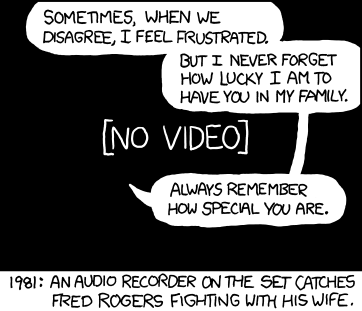
via xkdc. Mr. Rogers is one of my heroes. I wish he was still with us.

The Secret to Forgiving Yourself. Why is it that we’re often so much harder on ourselves than we would be on a friend who made the same mistake?

How to Shrink a City. A Boston Globe article on how cities in the US are coping with – and even embracing –  rapidly shrinking populations. The idea of crops growing next to multi-story apartment buildings in the heart of a city really appeals to me. It seems like it could bring out the best aspects of rural and urban life!

You’re Not Lost So Stop Trying to Find Yourself. Why living in the moment and embracing uncertainty are the only sane options.

Gender and Occupying One’s Own Personal Space. I’ve been trying to do this more and more. It’s hard to break old habits, but the social expectations of how little personal space women are supposed to use in public is fast becoming one of my all-time pet peeves.

What have you been reading?

Leave a Comment

Filed under Uncategorised

Pacifists and Horror Flicks

Despite the title, this isn’t just about watching scary movies or about nonviolence.  It’s about being incongruent.  Yes, I’m a pacifist who loves (certain) horror flicks. Fear and anticipation are a delicious elixir when one knows that they are, without a doubt, absolutely safe. I don’t like blood and gore, torture, or graphic scenes of violence but I love suspense.  The types of horror flicks that interest me, then, tend to be psychological thrillers. I like a little intellectual stimulation and moral ambiguity with my adrenaline. It’s rare to find a horror movie that combines these elements artistically so I don’t watch very many of them.

And yet there’s a part of me that is uncomfortable with this. I don’t always even like to eat meat because  some animal – a cow, a chicken, a pig, a fish, some shrimp, occasionally a deer- had to die in order for me to eat that particular meal. I can’t stand the sight of someone else in pain  in real life, but the threat of it onscreen sometimes is a good thing for a plot. How do I justify these conflicting beliefs? Well, I don’t know that I ever have. I’ll often go a year or so between scary movies because I’m not sure how to, on the one hand, feel just a little guilty for eating meat when I willingly watch movies or TV shows that glorify violent responses to conflict.

The only real defence I can muster of the irregularities in my beliefs and actions in this regard is that stories aren’t real. If someone was actually being chased down the street by a knife-wielding fiend, if the dead really were restless, if aliens actually were on the warpath, I’d protect as many people as possible. Or maybe I’d run and hide with everyone else who doesn’t have super-strenght or a firearm. But I definitely wouldn’t think of it as entertainment in the even most embryonic sense of the term.

So, this is my half-formed thought of the day. What do you think?

Leave a Comment

Filed under Uncategorised