
How to Avoid Guided Imagery

In the 6th grade one of my teachers decided to exercise our imaginations through guided imagery. With eyes closed and heads bowed on our desks, she asked us to imagine ourselves on a lightly scripted adventure that she read aloud to the class.  Sadly, I no longer remember all of the images with which she asked us to pretend we were interacting. There was a door, a being or guide of some sort, a message and a waterfall (or maybe that aspect was left up to our imaginations and I can only remember choosing the waterfall?)

One of the benefits of being a preacher’s kid, I thought, was that I knew how to avoid the the pitfalls of guided imagery. Earlier that year I had read a Christian adventure novel about demonic possession. One of the characters in the book, a young child, was asked to meet a special friend in his (or her?) imagination at school. Because this was a Christian novel, of course, the special friend turned out to be a demon and while I was fairly certain that my teacher wasn’t trying to incite a mass possession one could never be too careful. 😉

I decided, then, to only pretend as though the images flickering in my mind were being guided into any particular thought. Her voice carried us into a story; I followed as far as I dared, pulling back and peeking around the room every so often to see what, if anything, might be staring back at me. When the exercise ended I dutifully wrote and handed in a piece of dreck, careful not to believe a word of it or even to think about what I was writing any more than necessary.

For the rest of that school year I kept this incident in the back of my mind, watching and waiting for the teacher to bring up this exercise once again or to ask us to consult with our imaginary guide on other issues. She never did and I moved on to junior high the next year, quietly relieved, never to see or speak to her again.

After a time I realized that there weren’t any demons to worry about that damp, cold afternoon, that she was honestly just trying to stimulate our imaginations and that by making up a story I had actually fulfilled the criteria in her lesson plan beautifully.

As as adult I am grateful for this early infusion of skepticism, for getting into the habit of not automatically doing or thinking what everyone else is doing or thinking simply because an authority figures says it is a good thing to do. Sometimes, yes, there’s a good reason why everyone else is doing something a certain way. Not everything in life needs to be re-invented but that doesn’t mean I will stop considering the whats, whys, hows, and what ifs along the way!
Leave a Comment

Filed under Uncategorised

Suggestion Saturday: October 16, 2010

Here is this week’s list of blog posts, charts, novellas, videos and other tidbits from my favourite corners of the web.

Female Characters Flowchart. I wonder how this chart would look if there were more women writers working behind the scenes in the entertainment industry?

Germ Theory Denialism. Are vaccines always a good thing? I’d argue no. The HPV vaccine, for example, has yet to be shown to be safe or effective over the long term. Denying germ theory, though, requires a level of distrust in modern medicine that I cannot muster. Do we really want to go back to believing that bad air is a good explanation for the spread of disease? :O

Lucy Hardin’s Missing Period. When I was a kid I seriously loved the Choose Your Own Adventure books. This online novella is an adult version of that series. In it you learn about the life of Lucy Hardin and periodically make decisions at key points in the story. There are hundreds of different variations on this story that can be created based upon what you think Lucy should decide about even mundane choices. A word of warning for those who are very sensitive about these matters: some of the story lines lead to Lucy experiencing a miscarriage or abortion. In others, she has a baby. Nothing about her life is set in stone.

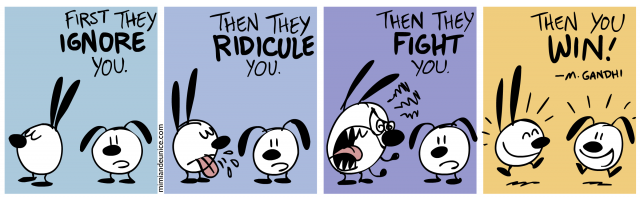
This is so true:

Why I Will Always Be Agnostic. The only thing more intriguing than talking about (dis)belief is translating the variety of our beliefs into a scale.

What have you been reading?

2 Comments

Filed under Uncategorised

Religious Aspects of Positive Thinking

I recently finished Barbara Ehrenreich’s new book Bright-Sided: How the Relentless Promotion of Positive Thinking has Undermined America. Her premise: the US (and Canada, too, I’d argue) pushes everyone to maintain unbridled optimism about anything and everything that may come their way. Even cancer. The problem is that thinking positive thoughts doesn’t change the outcome of cancer treatment or of anything else investigated in this book.

Religion and positive thinking are both guilty at times of giving our thoughts far too much power. As I said earlier, the problem with positive thinking is not optimism, it’s expectations. There’s nothing wrong with looking on the bright side or expecting that everything will eventually work itself out for the greater good. There is a big problem, though, with the magical thinking that often accompanies persistent optimism. Thoughts cannot be weighed or measured. They cannot bring down the wrath of the gods if  the wrong idea flits through your head. Certain thoughts can be harmful if they lead you to do or say something hurtful (or if they’re a symptom of mental illness and you’re not able to shake off  the burdensome ones.)

It is true that positive thinking is not a religion in the sense that it worships a god or gods. But it does have a mystical quality to it all: follow these steps, say and do these things, believe in this idea (and never that one), and all of your problems will melt away. If your problems don’t go away, if you doubt, if this system doesn’t work for you for any reason,  it’s because you were never a true believer.

There is no middle ground here. No fine print. It’s one size fits all in a world with an infinite number of sizes and shapes. Imagine a board with a series of holes lined up in neat rows from top to bottom. Each hole is just large enough for a small rubber ball to fit through it. It isn’t big enough to pass wooden building block through it, even though some of the other people in the room thinks that everything in the room – the building blocks, the potted plant in the corner, the windows, the desks, the chairs – should be able to fit through that hole if one tries hard enough and cultivates the correct attitude and thoughts.

This isn’t the way life works in the world that I live in. I understand that these types of black-and-white absolutist statements are a source of comfort and stability for many of the people who subscribe to various religious beliefs and I’m happy for those for whom these ideas genuinely work. It doesn’t mean that I’m going to start chopping up the chairs, shattering the glass in the windows or digging the plants out of the soil so that they can fit through the holes in the board in my imaginary room, though.

Leave a Comment

Filed under Uncategorised

Cultivating Gratitude

Most human beings have an almost infinite capacity for taking things for granted. – Aldous Huxley

“It’s all very well to read about sorrows and imagine yourself living through them heroically, but it’s not so nice when you really come to have them, is it?” – Anne Shirley

Happy Thanksgiving to my fellow Canadians!

Celebrating this holiday in October was a bit of an adjustment for me when I first moved up here. Growing up in the US I had always just assumed that everyone observed it at the end of November with us and so at first it was sort of strange to have Thanksgiving a few weeks before Halloween.

Traditionally this has been a time to reflect on everything in life for which we are grateful. I loved being with my maternal grandparents at Thanksgiving as a child and young adult. Not only was the table laden with all sorts of good things to eat, my grandfather was always almost painfully grateful to be surrounded by happy, healthy family members each year. He grew up in rural Ohio during the Great Depression and World War II. As a young boy he was in an awful accident when a wagon he was riding in collided with a train. Many of the other children on that hay ride died that day. One family buried all four of their children.

I don’t think we will ever truly know what deep impressions those experiences left in him, any more than I could step into your shoes or you could try on someone else’s life experiences for a time.

It makes me wonder how we can be grateful for what we cannot imagine happening. I’ve always had a roof over my head, a loving family, a warm place to sleep, a belly full of food, and medical care when ill. Intellectually I know that a day could come when I don’t have access to some or all of these things but it’s hard to imagine a life without any of it.

Gratitude seems to me to be a process of realizing that not everyone has these things and that we could easily be one of those people if it hasn’t happened already. It isn’t an easy task and definitely cannot take the place of actual life experiences, but it does stretch one’s mind and help us (or at least me!) not to slump into assuming everything good in life will always be there.

Once again I will end this post with a few questions. What are you taking for granted today? For what are you grateful?

5 Comments

Filed under Uncategorised

Suggestion Saturday: October 9, 2010

Here is this week’s list of blog posts, charts, web series and other tidbits from my favourite corners of the web.

Salt Shaker Hidden Safe. How to hide small valuables in plain sight. I wonder what other everyday items could be used as miniature safes?

Chart on Healthy Communities. The blogger who posted this chart was mostly focused on religious communities. It applies to all sorts of communities, though: workplaces, school, civic organizations, etc. In my experience the tone of a group can be changed for the worse by as few as one or two people. Improving it generally requires that more people actively work at it.

Masked Avengers Are Real. Or at least they are in Wisconsin. The world would be a better place if every neighbourhood had a few superheroes walking around at night!

Vag Magazine. Check out these teasers from a new comedic web series about a group of third-wave feminists who run a magazine. It was as funny to watch as it was to imagine what they will satirize next! Despite the title this is a work-safe link.

Citizens or Neighbors? On a more serious note Julie Clawson recently shared an excellent blog post about the different between being a good citizen and being a good neighbor (or neighbour here in Canada. 😉 )

Allowing the laws of the land to stand in the way of love is not what it means to live out what Jesus was encouraging in that parable. Standing by and watching a house burn down and pets be burned alive because of a $75 fee is not being a good neighbor. Nor is letting someone die because they aren’t rich enough to afford insurance. From a certain political perspective it can be justified as being a good citizen, but that is not even close to being the same thing.

What have you been reading?

Leave a Comment

Filed under Uncategorised

The Church Intent of Nuit Blanche

My favourite Nuit Blanche exhibit this year – and quite possibly my favourite exhibit of all time from this event – was John Notten‘s Church Intent, a juxtaposition of Christian symbols and camping gear. Click here for a computer generated walkthrough of the exhibit. It doesn’t show all of the smaller works inside of the tent, but it does give a good feel for what it was like to walk through this exhibit.

Normally I weave together a monologue on whatever it is that has piqued my interest at the moment. For many subjects this works well. Art is better understood in conversation though, so this week I will instead be asking questions. Feel free to answer any or all of them (or ignore them entirely if you’ve thought of better things to discuss here!)

What is your favourite work of art? Why did it first capture your attention?

To what extent are our most deeply held beliefs, religious or otherwise, influenced by the culture(s) we live in? How can we puzzle out where one ends and the other begins?

Theists, how have you experienced God in everyday life? Is there a connection between your interests or hobbies and your religious beliefs?

Non-theists (or Agnostics), what, if anything, gives you a sense of wonder about the world?

Leave a Comment

Filed under Uncategorised

Cable-Free: One Month Update

Now that we’re about a month into the new TV season I thought I’d give an update on our cable-free experiment.

So far we have had little to no trouble finding most of our favourite TV shows. At times I do have to wait a day or two for certain shows to become available for download, and certain ones are not always easy to find, but once I figured out that my shows will show up eventually it quickly became part of everyday life.

The price of individual iTunes episodes turned out to be a little more expensive than we had originally thought, so we did cut back on a few shows that, while interesting, didn’t seem worth the extra two to three dollars per episode. Small amounts here and there can add up quickly by the end of the month! I’d like to see the price come down for individual episodes on iTunes in Canada, especially for the half-hour programs. Right now it costs less to rent some movies that it would to rent two episodes of a sitcom that, added together, only provide about 45 minutes of entertainment.

It doesn’t make sense and I honestly think they would make more money if the price for individual hour-long shows went down by a dollar or two and if half-hour shows were just a little less expensive than that. At this point, viewers have a real disincentive to choose shorter programs when we can watch an hour long show or a movie for the same amount of money.

Download speeds do seem to vary quite a bit depending on the time of day. We’ve learned to download our shows first thing in the morning if at all possible, as they seem to finish more quickly that way. Downloading more than one show at a time also seems to help speed up the process. (Or maybe it just seems that way because I have more than one show to look forward to? 🙂 )

If there’s one thing I haven’t missed one bit, it is commercials. I can’t stress enough how nice it is to avoid these interruptions, especially in our drama and scifi/fantasy shows where it is very common to cut away at the most inopportune scenes. Once or twice now I’ve stumbled across a traditional television program while away from home. No sooner do I begin to become interested in a program than a commercial pops up. These interruptions are becoming an excuse for me to wander away from the screen and do something else every 5 minutes. I think I’m losing my tolerance for commercial breaks as I don’t remember noticing them so often in the past!

As the weather grows colder, Drew and I are spending more and more time indoors watching our shows, reading and surfing the Internet. The temptation to follow more and more interesting shows is only going to grow for us as winter approaches and the average daily temperature drops closer to freezing. I’ve been trying to come up with alternative (and free or inexpensive) indoor activities so that we don’t spend too much time staring at computer or television screens.

Honestly, I wish we’d done this a year or two ago. The benefits far outweigh the occasional slow download time, new episodes that take a little extra time to show up, or the temptation to begin watching more and more programs over time.

7 Comments

Filed under Uncategorised

Suggestion Saturday: October 2, 2010

Here is this week’s list of blog posts, poems, photos and other tidbits from my favourite corners of the web.

Dirty Feet. Did you know that washing someone’s feet in biblical times was like cleaning their toilet today? I’ve never heard this before. If there are any biblical scholars lurking out there, what do you know about it?

If Men Could Menstruate.  One of the benefits of growing up with a nurse for a mother  is that I never thought of my monthly cycle as something shameful, disgusting or spiritually significant. It was just a bodily function like digestion or respiration. I suspect that these attitudes were more common a few generations ago or maybe I’ve just happened to meet far more people who agree with me than is representative of this view in the generation population?

Why I Think Being a Nerdy, Bisexual Female Rocks. I thought I was the only person to have contingency plans in place for even the most unlikely scenarios. It appears, though, that I am not alone in this regard. 😉

Had Edgar Allan Poe Been an Emergency Nurse. A funny poem about an emergency nurse treating an intoxicated patient.

The Art of Cutting Leaves By Nature’s Art. This is what it would look like if the concept of artistic expression could be distilled into four leaves.

What have you been reading?

6 Comments

Filed under Uncategorised

The Care and Feeding of Ideas

Every September there is a fantastic book festival here called Word on the Street.  Everyone who values knowledge and the free exchange of ideas belongs there, regardless of age, background or worldview. Imagine a city park filled with booths promoting graphic novels, children’s stories, magazines, literary journals, literacy foundations, religious groups like Muslims and a spattering of neopagan and new age gurus, and even some authors promoting books that I think were self-published.

In the middle of the park one can find poetry and dramatic readings, special speakers on a variety of social and ethical topics, political debates, and Q&A sessions with a wide variety of publishers, authors, and bloggers. Many of the views represented each year are contradictory. It doesn’t matter, though, because this is a festival of curiosity, wonder at the world around us, and the cross-pollination of ideas.

Ideas rot from the inside out if we never test them, share them with others, or listen the views of people who see the world in a different way. It doesn’t matter what the idea is, isolation breeds extremist views that can do much more harm than good.

Think of what would happen if a small group of people were secluded from the outside world.  Sooner or later, their descendants will become inbred and if new members are not at least occasionally introduced the community could easily die out altogether. Relying on the same gene pool (or way of looking at the world) year after year increases the chances that recessive genes (or  really, really bad ideas) will pop up.

This is why I love Word on the Street. Yes, the food is delicious. Yes, it is wonderful to discover new authors, listen to discussions about e-books and blogging, or pick up free bookmarks or magazine samples at the booths. The exchange of  ideas, though, is where the magic happens. Even in a large city like Toronto people tend to drift to other people who think, act and believe like them. This may be a diverse city comprised of  many different communities but these communities still look and act like a small town in both positive and negative ways. A close-knit community can be fantastic support system; it can also be unbelievably suffocatingfor anyone who cannot fit the mold of who or what someone in that community is supposed to be.

Slowly I have been accumulating friends who value the art of conversation, who don’t expect anyone to change his or her mind or for any sort of consensus to be agreed upon. I just wish I knew how to stumble upon them more quickly!

8 Comments

Filed under Uncategorised

The Ethics of Mummies and Museums

I recently visited the museum again, this time concentrating on the Ancient Egypt exhibit . It featured two mummies: one who was displayed with his original sarcophagus and a mummy of indeterminate age and gender from an earlier era when bodies mummified accidentally/naturally from being buried in the sand in a dry, hot climate. There was something odd about standing next to the remains of two people who were once someone’s child, spouse, sibling, parent, friend even though everyone who knew and loved them has been dead for thousands of years.

I have certain ethical hesitations when it comes to displaying human remains from ancient cultures for the entertainment of others in general. Strangely enough, I don’t have the same feeling of ick about the cadavers used in medical schools or even the Bodyworlds exhibit that visited Toronto last year. (As an aside, the latter was one of the most educational experiences of my adult life. I’d never realized how fragile our systems are, how easily a pregnancy, a bone, a heart, a blood vessel can break down.)

We can learn a lot about a society – their diet, general health, burial rituals, afterlife beliefs, etc –  through the archeological study of their grave sites and remains, of course. It would be a real shame to lose the knowledge of past civilizations that we have gained or will gain in future expeditions and I completely understand why archeologists dig up and study these things.

I also know that some Native American tribes are very upset  with museums who display the bones of people who were unearthed on land that traditionally belonged to certain groups. It isn’t always possible to pinpoint the racial (much less tribal) identity of a skeleton, of course.  Erring on the side of caution is an admirable trait and while I don’t have a problem with the general scientific study of mummies, skeletons or other human remains I don’t think it should ever be done against the will of that individuals probable descendants or ethnic group. A corpse can’t give consent, of course, and if there is such a thing as an eternal soul I doubt that they are that concerned with what happens to their shells after death. But those left behind do care in certain cases, even if the individual in question has been dead for a few hundred generations.

Is the human body sacred? I don’t know what I think about that term, but I would argue that human remains should be respected for the people they once contained and for their cultural beliefs about death, burial and the afterlife (assuming that we know enough about their culture to make an educated guess as to whether they would find the exhumation of a burial site to be ethically objectionable. If the culture is not known well enough for us to figure this out, I don’t think there’s anything wrong with learning everything we can about them.) There is a balance between respecting a culture and the person-who-was and the advancement of scientific knowledge that we have yet to reach. In some cases maybe there cannot be a compromise: either we excavate a newly-discovered ancient burial ground or we don’t.

I don’t even know exactly what I’d change about the presentation of the Egyptian mummies themselves to make it feel more ethical. A cultural shift in which we acknowledged the lives that these individuals lived seems more appropriate. But you can’t exactly legislate culture and dimmer lights or a sign asking people to be quiet in that area probably wouldn’t be effective. If nothing else, I’d like to see human remains only displayed for limited amounts of time . Whether that is measured in weeks or months or years, I don’t think any human body parts should be indefinitely under the public eye. At some point they should be laid to rest again, if only in a quiet storehouse of scientific discoveries somewhere.

And so I end this post just as conflicted as ever. Is it always unethical to display human remains? I don’t think so, no. But our current standards don’t seem to be entirely appropriate either. There is a line between education and entertainment. The former seems like an appropriate use of human remains; the latter sticks in my craw. But I don’t quite know what to do with displays that are of both educational and entertainment value.

Thoughts?

3 Comments

Filed under Uncategorised