Incidentally, I’ve also pick up some fabulous ideas for poems and stories as well by watching people! You’d be surprised by how much you can learn about writing dialogue as well as human nature in by quietly observing how they interact with each other in public. Perhaps this should be the topic of a future post? What do you think?
From What Is the Difference Between Mindfulness and Meditation?
A few years ago, I mentioned wanting to blog about eavesdropping as a tool for improving your writing. Today I’m finally digging into this topic in the form of telling a few true stories!
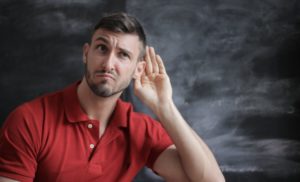 One of my college professors sent us out to eavesdrop as part of a creative writing assignment. We were instructed to write down the conversation and then analyze the flow of it in order to make the dialogue in our stories more realistic in the future.
I shared no hints about the identities of the people I eavesdropped on in my assignment in order to protect their privacy. It was only about listening to the way people really speak in casual conversations.
For some reason, there weren’t a lot of talkative students at my college when I ventured out to work on this assignment. It took a few tries to overhear anything useful, and the conversation I eventually found myself listening to involved a date a fellow student had recently been on and how it had unfolded.
If only I could have heard his date’s version of their time together! He seemed to take the entire experience very lightly, almost like a joke. I still wonder if she reacted to it the same way.
What I remember the most about that experience was how fascinating it was to only have pieces of the story. I could certainly extrapolate all sorts of things about how he spent his free time and where they might have met, but the nature of human conversations means that all sorts of questions will go unanswered if you drop into the middle of a story.
 Listening to the way people really speak was also incredibly informative. The conversation I overheard was filled with friendly interruptions and all sorts of detours into other, mostly-related topics.
After turning in my paper, I quietly decided to continue eavesdropping over the years.
A few years after that I was taking a bus trip and happened to sit next to two young girls who seemed to be pretty unfamiliar with rural life.
One of them spotted a house in the distance. She hadn’t realized that people lived “out in the middle of nowhere” (read: not in a city or town) and wondered how they managed to keep food in the house without any stores around!
Her friend was just as puzzled as she was. There was no resolution to be had for them that day in how “those poor folks” managed to stay fed.
I gently bit my lip to avoid publicly reacting in a way that might cause her any embarrassment at all. Like I said, they were quite young and may never have thought about these things before.
Several years ago, my spouse and I decided to grab lunch at a local outdoor burger joint that serves amazing french fries. Our fry order was ready before our burgers were finished, so I carefully carried them over to a nearby table and sat down to wait for my spouse the rest of the food.
A preschooler suddenly zoomed over and sat in the chair next to me, a perfect stranger. His mortified mother called him back over again.
He refused to budge. There were enough french fries there for more than one person, so of course the nice lady would share with him! (Actually, I would have been happy to share a bite or two if I’d known his parents and had their permission).
She called him over again, telling him it was rude to interrupt someone else’s date. I chuckled as he admitted defeat and slunk back over to her without a single fry for his efforts.
Had she already ordered fries for him? Did he grow up in a family where all of the grown ups shared their food with him? I have so many unanswered questions there, but it made for a pretty funny moment.
 None of these anecdotes have made it into one of my stories (yet?), but they have taught me about the ways people think and how many different ways the same tale can be told depending on whose perspective you look at.
Humans are delightfully unpredictable creatures.
Your interpretations won’t always match mine and vice versa. I’m sure that all of these folks would remember details of those days that I’ve forgotten or that I interpreted in different ways.
The beautiful thing about listening is just how much it can reveal.
 On any given day, I’m brainstorming, writing, or reworking blog posts, my latest novel, future social media posts for myself, future social media posts for the organizations I volunteer for, book reviews, and more. If one of these writing styles isn’t working for me, I’ll switch to another one.
 I can’t tell you how many times I’ve talked to my characters. No, I generally don’t speak out loud to them, although more power to you if that works.
 For example, I generally find it much easier to write the middle of a story or novel than I do the beginning or ending. Beginnings need to draw the readers into the plot quickly while at the same time developing the character’s personalities and giving a good overview of what the world they inhabit is like.
 No, I’m not saying you need to publish what you write or that you need to start an entirely new project altogether. I’ve written plenty of scraps of things that will never see the light of day.
 Last autumn I blogged about
  Progress: Accomplished.
 Progress: Accomplished and still ongoing.
 Progress: Ongoing but looking good.
 There’s something about the autumn season that makes me want to write out lists and accomplish things. Maybe it’s because of how much I generally looked forward to school beginning again when I was a student.
 The other day I learned something surprising about bananas.
 True stories like this one are why I think creative writers – especially those in the speculative fiction genre who are often responsible for creating worlds that are very different from the one we live in – should read books about what life was like decades, centuries, and millennia before they were born.
 Let’s shift gears and talk about Stonehenge for a moment. When compared to what we know about World War Two (and bananas), our knowledge so far of what purpose Stonehenge was meant to fill, who created it, and why they went through all of the trouble of making it could fit into a thimble.
 The Abandoned House
 A Woodland Sacrifice
 This one is just plain silly.
 Lick My Lips
 The funny thing about being a fiction writer is how easy it is for your everyday life to seep into your work.
