Suggestion Saturday: March 11, 2017

Here is this week’s list of poems, stories, comic strips, and other links from my favourite corners of the web.

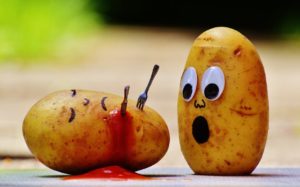
I’m Sorry Steve’s Dead, But Maybe He Shouldn’t Have Touched My Snapple. The picture on the left was the perfect accompaniment to this short story. The story itself is told in multiple parts, for the record. Scroll down to the bottom of this link to find the link to part two.

A Light Exists in Spring. This is one of my favourite Emily Dickinson poems.

Sync Your Breathing with This and Relax. I vaguely remember sharing links that were similar to this one in the past. What I really like about this particular site is how customizable it is, though. The nature sounds in particular were a nice touch. I loved breathing in deeply while listening to the gentle patter of rain.

Never Be Late Again with Teleportation via tjonesauthor. I sure like the sound of this idea. Traveling is not my idea of a good time.

Stargazing via adoptiveblkmom. What an interesting post. It reminded me a little of the long walks I used to take with my mom when I was a teenager.

The Wake Up Call. This is what I imagine Daylight Savings Time must be like every year if you happen to live with a cat or other pet.

Is It Worth It to Write Online Even Though the Platforms You Use Could Disappear? via breecrowder. I couldn’t agree with this more. It does make me wonder what percentage of the things we type on the Internet will still be around in a decade or two, though!

Comments Off on Suggestion Saturday: March 11, 2017

Filed under Suggestion Saturday

What Is the Difference Between Mindfulness and Meditation?

Both of these terms regularly get tossed around on this blog. I recently realized that I’ve never defined them or talked about the subtle differences between them. It’s high time to change that!

Meditation Is an Action

Meditation requires you to arrange your body in a certain position and actively clear all of the thoughts from your head.

It is a deliberate pause in your day that has a specific beginning, middle, and end. Think of it like brushing your teeth or doing some other routine

This isn’t something that can be multi-tasked. When you meditate, it is the only thing you’re doing at that precise moment in time. There’s no room for distractions or breaks during it.

Sometimes it even requires you to willfully continue to keep your mind clear of thoughts and focus on your breathing if you’re having a lot of trouble.

Mindfulness Is a State of Mind

Mindfulness, on the other hand, does not require this level of focus. It is about remaining aware of what’s happening to you at this precise point in time without living in the past, worrying about the future, or passing judgement on what I’ve observing.

I can and have practiced mindfulness while standing in line, listening to the rain patter against my window, waiting to hear the results of medical tests, feeling annoyed by a careless stranger who wasn’t paying attention to where he or she was walking, and watching a dog chase squirrels at the park.

There are usually other thoughts floating around in my head when I practice mindfulness. As long as I remain focused on whatever is happening in the present moment and aren’t making judgements, I allow my brain to think whatever it wants to think.

Often it begins to focus on the details of the room, park, store, or other place where I happen to be that day. I like the thrill of noticing little things in those settings that many people overlook like the color of a pet’s leash or how many pigeons were wandering around while they waited for someone else to feed them. I usually tend to rush past those things myself, so slowing down enough to pay attention to them is a wonderfully healthy thing for me to do.

You Can’t Have Meditation without Mindfulness

The biggest reason why I file the meditation posts under mindfulness here is that you can’t meditate without first learning how to be mindful. Every time I pause and pay close attention to my surroundings, I get just a little better at meditating as a result.

There is something so joyful about seeing how mindfulness affects my meditation practices. As I’ve mentioned in the past, meditation is something I struggled a lot with when I first began practicing it.

My mind really hated the idea of sitting quietly and doing “nothing” for any length of time. Learning how to quiet it without physically sitting down and participating in traditional forms of meditation was eventually how I learned to slide into this practice.

Mindfulness became a habit for me long before meditation did.

(Incidentally, I’ve also pick up some fabulous ideas for poems and stories as well by watching people! You’d be surprised by how much you can learn about writing dialogue as well as human nature in by quietly observing how they interact with each other in public. Perhaps this should be the topic of a future post? What do you think?)

Comments Off on What Is the Difference Between Mindfulness and Meditation?

Filed under Mindfulness and Meditation

What Cheesy Ghost Movies Can Teach You About Getting (and Staying) in Shape

One of my favourite things to do during a boring workout routine is to watch the kinds of ghost movies on Netflix that desperately try to be scary but end up being predictable and silly instead.

The nice part about these films is that they don’t require your full attention. Paying attention to 80% of the things happening on the screen is more than enough to figure out the plot twists well in advance, so they’re perfect for watching while you exercise.

The other reason why I watch these films is because there are lessons in every single one of them that would honestly work as well, and maybe even a little better, if you applied them to your workout routine instead of waiting until you move into a haunted house or accidentally knock over a gravestone to see how useful they’d be. Figuring out what those lessons are have also provided me endless amounts of entertainment on cardio days.

Lesson #1: Don’t Be Afraid to Take Advice from Others Who Have Already Been There

No one is ever too old to learn something new, and no one is ever too young to teach you something you didn’t know before.

I’m slowly forming a small group of fellow exercise enthusiasts who bounce ideas off of each other and ask for advice when there’s something we find challenging or confusing about our workouts.

Not everyone in this loosely-associated club of sorts practices the exact same routines, but we share enough in common that we can find those areas where we overlap and trade information about what does and doesn’t work.

There have been a few times when I’ve considered something and decided that it isn’t something that I should worry about for a wide variety of reasons, but I always listen to the reasons why someone gives for recommending or not recommending it before making my final decision.

Lesson #2: Always Tie Your Shoes

Have you ever noticed how often characters in horror movies forget to tie their shoes securely? Sometimes they have to do that in order to give a menacing ghost the chance to catch up with them once they run away, but the last thing you want to do while running or walking is step on your own shoelace and trip over your own foot.

I always double-check my shoes and anything else I’m wearing that could potentially cause an accident before I start working out. Sometimes I have even been known to double-knot my laces if I’ll be going somewhere muddy or cold. It isn’t much fun to tie laces when they’re covered in dirt or slush.

Lesson #3: If Something Feels Wrong, Don’t Ignore It

There’s a fine line between pushing yourself to do better and injuring yourself because you overlooked pain while you were exercising.

If a specific move sends a tingle down your spine in a bad way, stop immediately. Most people wouldn’t wander into a dark basement in the middle of the night to investigate a strange noise if their flashlight kept dying at the top of the steps.

Use that same common sense when you’re working out. There will be more opportunities to try that move again  once you’ve gained more experience or moved on to better equipment.

Lesson #4: Some Days Are Going to Suck No Matter What You Do

Just like some houses are so deeply haunted that you won’t ever find enough holy water to cleanse them, some workouts are going to falter for reasons you couldn’t possibly predict or prevent.

For example, I’ve had multiple workouts that were interrupted by fire alarms. Obviously, fire alarms can’t be ignored for all kinds of safety and noise reasons. When that alarm sounds, the only thing you can do is get to somewhere safe and wait for someone to turn it off.

On a less urgent note, there have been times when my workouts were cut short because I was recovering from an illness or injury that turned out to be further back in the healing process than I originally thought it would be. My spirit might be willing to push it to the limit, but my body is a completely different story in that scenario.

Your mental health matters, too. Occasionally I have a day when my workouts are begrudging at absolute best due to other things that are going on in my life at that point. The faster I accept that I won’t be breaking any personal records those days, the faster I can get through the routine and put as much effort into it as I can reasonably manage for that particular day.

Lesson #5: Practice More than One Kind of Exercise

Could you outrun a vengeful spirit? Could you pick up an injured friend and carry them to the car? Are you limber enough to turn to the side, stretch backwards, and unhook your jacket from that rusty nail sticking out of the door before the ghost comes back again?

Obviously these things aren’t literally going to happen, but the failure of many horror movie characters to stay in good shape is a reminder that there’s more than one way to be fit. Ideally, we should all be practicing as many of them as we can.

I have been walking long distances for a decade and lifting weights for a few years now. Yoga is the next form of exercise to check off my list in 2017. I hope I’d be able to do all of the things listed above in an emergency.

Lesson #6: Try, Try Again

Not everything in life happens right away. As I blogged a few weeks ago, yoga wasn’t something I liked the first or even the second time I tried it.

Even now I’m not entirely sure what I think about this form of exercise, but I continue giving it chances to change my mind. Just like it can take horror movie characters more than one visit with a psychic to convince a restless spirit to move onto the next world, sometimes new workout routines need some time to settle into a groove as well.

If you truly don’t like it, there’s nothing wrong with admitting that and moving onto something new.  Don’t assume that your first impression of something will be your last one, though. People’s opinions change every day if they give themselves enough chances to decide what they really think about a specific form of exercise.

Lesson #7: It Never Ends

There will always be something new to learn.

You could always be a little stronger, faster, or more flexible.

Someone else will always need your advice.

There will always be other people who will have good advice for you if you open yourself up to it.

What about the spirits?

Yes, they will always return in the sequel regardless of how well you think you vanquished them at the end of the third act in the original film.

Comments Off on What Cheesy Ghost Movies Can Teach You About Getting (and Staying) in Shape

Filed under Fitness

Suggestion Saturday: March 4, 2017

Here is this week’s list of poems, predictions about the future, open letters, and other links from my favourite corners of the web.

Late February. This poem perfectly captures what this time of year feels like. I wish I’d found it earlier so I could have included it in last week’s Suggestion Saturday post!

Extremely Fair via SHLubin. There’s a lot of information to process in this post. I read it a few times, and I’ve also been following the #ExtremelyFair hashtag on Twitter to see what other people had to say about it.

My Father Saw via SabeehaRehman. Every family should record and pass down oral histories like this one. Wow!

A Letter to Hermione Granger via SanchWrites. What an interesting idea. I’d never thought about writing a letter to your favourite literary character before.

Mars Needs Lawyers. I love these kind of speculative but still realistic predictions about what could happen in the near future.

Will Democracy Survive Big Data and Artificial Intelligence? This is another long article, but it’s a good one.

From The Epidemic of Gay Loneliness:

The term researchers use to explain this phenomenon is “minority stress.” In its most direct form, it’s pretty simple: Being a member of a marginalized group requires extra effort. When you’re the only woman at a business meeting, or the only black guy in your college dorm, you have to think on a level that members of the majority don’t.


Comments Off on Suggestion Saturday: March 4, 2017

Filed under Suggestion Saturday

5 Unexpected Things that Can Make You More Mindful

I’ve been thinking about mindfulness a lot lately. It’s a habit that needs to be built up and reinforced over a long period of time. Mindfulness is not the sort of thing that you can achieve in an hour, a day, or a week.

With that being said, there are certain experiences in life that can give you valuable opportunities to become more mindful.

Waiting in Line

One of the easiest but also most surprising changes that came into my life when I started trying to be more mindful happened the next time I stood in a line.

Rather than impatiently wondering how much longer I’d be waiting or why some shoppers wait to begin to search for their wallet until every single item has been bagged and scanned, I started framing this as an opportunity to observe how people behave when they have nothing to do.

Some folks become so engrossed in their smart phones that they don’t notice anything going on around them. Others try to strike up a conversation with the first person to catch their eye. (The jokester in me wonders if the first group is always desperately trying to avoid the second one!)

You will overhear interesting snatches of conversation as well. People will talk about all sorts of things if they get bored and restless enough. The conversation I found most thought-provoking, believe it or not, had to do with whether or not a child truly needed more socks. One of the adults who was buying clothing for her thought she did. I can’t remember what the other one said, but it was fascinating to listen to them quietly discuss how many socks a child truly requires.

These days I enjoy watching the crowd move so much that I’m actually a little sorry when I reach the front of the queue and can no longer quietly pay attention to people who are standing so close to me.

Not Getting What You Want

Many years ago I interviewed for a job that I desperately wanted. It was with an organization that shared some of my biggest ideals, and so I began dreaming about what it would be like to be paid to pursue them. The hours, location, responsibilities, and salary were also exactly what I was looking for.

I thought I had a good shot at being offered it, so I was crushed when that didn’t happen.

It took me a long time to get over that dream I’d imagined. One of the things that helped the most was focusing on what I could do in that exact moment to feel better.

I couldn’t have the experiences I’d fantasized about, but there were a lot of other things I could do to cheer myself up as well as to prepare for future opportunities that were sure to come my way.

Government Bureaucracy 

Is there anything more annoying than waiting for a government agency to process your paperwork or make a decision?

I’ve had a lot of experience with this one. Becoming a Canadian citizen is an opportunity to live in the moment that literally lasts for years. There are so many steps along the way that you have no control over whatsoever.

Once you file all of the appropriate paperwork, it’s up to government employees that you’ll never meet to decide whether to approve, delay, or reject your application. They are impervious to how long it might take to process your application or how anxious you are to know the results.

If I could go through the process again, I’d be much more relaxed this time around. Waiting for the government to make a decision would give anyone the patience of a saint.

There are so many other examples I could give of how dealing with bureaucracy can actually be a good mindfulness tool, but I think I’ll save them for a future blog post.

Injuries, Pain, and Illnesses

Whether you’re waiting for possibly scary test results from your family doctor or figuring out how to go grocery shopping when you’re having trouble walking, injuries and illnesses provide a wonderful opportunity to live in the moment.

There is nothing anyone can do to speed up the amount of time it takes to find out if you have a life-threatening disease or for a broken limb to fully heal. In the meantime, you are left with a body that isn’t behaving the way you’d like it to.

My experiences with this have been mild and transitory so far, but there still have been a few times when I lived in limbo for a while. I’d be lying to you if I said that I was always peaceful during those long waits. It’s frightening not to know what the future holds, and I am definitely not a mindfulness guru.

With that being said, keeping my attention on what was happening in the present moment did help me to worry less about what might or might not happen to me in the future.

Grief

Someone I knew died years ago before they had a chance to tie up all of the loose ends in their life. Our relationship had been  complex and sometimes difficult for many different reasons, so I was surprised by the grief I felt after they were buried.

There had always been a small part of me that held onto a faint hope that our relationship would eventually improve. Having that sliver of hope snatched away for good was sad.

You can’t change the past, though. It is what it is, and remaining mindful as I adjusted to this change in life helped me to accept the finality of this person’s death. Not everyone gets the chance to fix the things they could or should have tried to fix much earlier on in their story.


Comments Off on 5 Unexpected Things that Can Make You More Mindful

Filed under Mindfulness and Meditation

What Will Exercise Routines Be Like in a Hundred Years?

A new fitness fad comes along every decade or so. There were gentle stretching exercises for ladies in the 1910s, twist dances in the 1950s, aerobics videos in the 1980s, and Zumba classes in the 2010s. (If you haven’t seen it already, this video shows 100 years of fitness in 100 seconds).

A hundred years ago, exercise was built into everyone’s day. The vast majority of people didn’t own cars or many other modern conveniences back then. They walked or rode a horse into town, chopped wood, scrubbed their clothing by hand, planted, weeded, and then harvested their crops, preserved food, repaired their wagons and tools, carried buckets of water to the plants and animals under their care, and did many other physically demanding chores from morning until evening.

The First Half of My Prediction

As fossil fuels become far more rare and expensive, humans will start adding some of these activities back into their daily lives in order to save money. Walking a couple of miles to a nearby destination only costs as much extra food as it will take to fill your stomach once you need to eat again. While this has already been a common thing here in Toronto for many years, I see it becoming much more socially acceptable to walk to all kinds of places in suburban and rural communities, too, in the coming years.

Eventually the price of driving to all of those locations is going to be too high to do anything else on a regular basis. As grocery store costs rise, I wouldn’t be surprised if it also became more common for people who own a patch of unused land to start growing and preserving some of their own food again as well.

Exercise will no longer be about purposefully lifting weights or setting aside half an hour a day to break a sweat. People will naturally need to do these things during their daily routine in order to save money or maybe even to survive in general. This is going to change everything from what folks do for fun to how far away from their jobs or schools they’ll be willing to live.

I wouldn’t be surprised if tele-commuting became almost universally available for students and workers alike, especially for those who aren’t able to live closer to town for any number of reasons. Why physically go into school or the office if you can get all of the same information online while saving valuable money and time on the commute?

The Second Half of My Prediction

The other thing I see happening with exercise in the future is it becoming much more technologically-aware. We have just entered the age of digital fitness trackers, and I only see them becoming more important in the future for many different reasons.

Imagine students who are enrolled in online schools getting credit for gym class while they’re digging potatoes out of the garden or wiping off the solar panels next to their house. Some kids would respond much better to this than they would to playing the kinds of team sports that are generally shown as examples of staying active. I know that I would have been much more interested in gym class had I been shown a wider range of ways to stay fit and then been allowed to pick a few that interested me the most. There’s nothing wrong with liking football or basketball, but there are so many other forms of exercise out there!

Think about how much information your family doctor could get about your health if he or she was able to see an average of how many minutes of exercise you’ve gotten per day for the last year as well. Maybe he or she could also see your blood sugar levels, blood pressure numbers, and resting and active heart rates, too. I’ve known people whose blood pressure rises dramatically whenever they have it checked at the doctor’s office because they get so anxious around people in the medical profession. These sorts of changes to the way health data is collected could give doctors a much more accurate picture of how their patients are really doing.

Insurance companies could give discounts to people who agreed to share their activity levels or who showed a steady increase in the number of minutes of exercise they did every week as well. While I would never agree with forcing people to share this kind of information in order to qualify for insurance coverage, it could be a nice incentive for folks who want to save a little cash and begin some healthier habits at the same time.

Will some of these predictions come true far sooner than 2117? I wouldn’t be surprised if they did, to be honest. It will be interesting to see how technology and exercise continue to develop over the next few decades. Only time will tell if I’m right about some, all, or none of the societal changes I think are on their way.

Comments Off on What Will Exercise Routines Be Like in a Hundred Years?

Filed under Fitness

Suggestion Saturday: February 25, 2017

Here is this week’s list of stuff from my favourite corners of the web.

Counting Steps to Increase Physical Activity. Is everyone staying active this winter? I use a program similar to this one, and it’s been effective for me.

Orthorexia Nervosa “Unhealthy” Healthy Obsession via Charmsthefoodie. This is a self-test for an eating disorder called Orthorexia. While it wasn’t included in the DSM-5, I’m hoping it will be included in the future.

34 Books by Women of Color to Read This Year. I love these kinds of lists.

How Writing Poetry Every Day Made Me More Patient and Emotionally Resilient via businessinrhyme. I’d especially recommend this link to those of you who are poets.

Fantasy Novel Title Generator. This might work well for pet names, too. “Hero, Dragon, and Child” could be a book or a trio of mischievous cats that you’ve just adopted from the local animal shelter.

Motivating Factors in My Life via WomenWriters. What life was like for this writer who was stuck in a bad marriage in the 1960s.

From Helpful Tips for Biphobics:

Being biphobic is currently a popular sport for many, and does appear at first glance to be a simple task. However, it’s not as easy as it may seem, so I’ve compiled this list to help you be aware of the many pitfalls you might encounter.

First, it’s important to understand that as much as the intent of your biphobia may be to hurt bisexuals, you may be inadvertently helping them.

What have you been reading?

Comments Off on Suggestion Saturday: February 25, 2017

Filed under Suggestion Saturday

5 More Modern Scifi Books You Should Be Reading

Last month I recommended five modern science fiction books that I really enjoyed to my readers. Today I decided to write a follow-up post so that I can recommend even more great reads to you! Who knows? Maybe this will become a series on this blog. We will see what happens in the future.
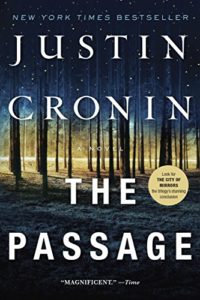
The Passage by Justin Cronin.

What is it about?

A virus turns humans into vampires so quickly that our species is now on the brink of extinction.

An FBI agent suddenly finds himself in charge of keeping an abandoned child safe in a world where no child is safe anymore.

Humanity must adjust to this new world, so the rest of the plot is about how that happens over a long period of time and what happens when the precautions people take to protect themselves begin to fail.

Why should you read it?

This is one of the most suspenseful and action-packed books I’ve read in a long time. Dividing it up into sections that told different pieces of the same story was a good idea. In some ways, it was sort of like three novellas set in the same universe one because each section was focused on such a specific part of the storyline.

One of the other things I appreciated about it was that the vampires weren’t misunderstood, secretly romantic, or anyone’s boyfriend. They were violent, dangerous, ugly, and menacing. This black-and-white approach to the genre was refreshing. I really like it when monsters act like monsters.

Oryx and Crake  by Margaret Atwood

What is it about?

It’s a dystopia set in the near future. Jimmy, a man who thinks he’s the last living human on earth, is grieving the loss of his friends Oryx and Crake.

His only companions are the Children of Crake, a small group of genetically-modified, human-like creatures who are about as intelligent as the average 7-year-old child. They think of him as a messenger from their creator and obey his every command.

The plot thickens when Jimmy runs into his old friends and realizes that he isn’t alone after all.

This is the first book in her MaddAddam trilogy. If you like it, the next two books in the series are just as excellent.

Why should you read it?

The first thing that drew me into the plot were all of the flashbacks to life right before society collapsed. Your social class determines everything from what kind of school you’re allowed to attend to how much food you have to whether or not you survive in this society. It is a very rigid system that’s basically impossible to escape.

The Children of Crake weren’t the only genetically modified creatures in this universe. In fact, they weren’t even the most interesting ones!

I also enjoyed the storytelling. This is something I’d especially recommend to anyone who has read a lot of science fiction or who is already a fan of Margaret Atwood’s writing in general. She plays around with this genre in some pretty spectacular ways.
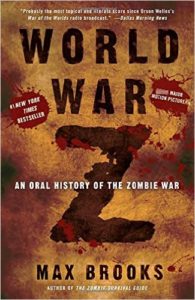
World War Z: An Oral History of the Zombie 

What is it about?

This is a collection of interviews done with people of all ages and backgrounds who survived the zombie apocalypse many years after humanity more or less won the war.

Patient Zero’s experiences are included early on. Most zombie fiction doesn’t bother showing where the virus comes from or how it started to spread, so I was fascinated by this section.

Another interview is with a feral child who somehow escaped being attacked and then survived alone in the woods for years before finally being rescued. Despite being much older now, this witness will always remain a small child as far as their mental understanding of the world goes.

There is also a dog who was trained to fight the zombies as part of a military strike against them. That interview was obviously done with one of the humans who worked with the dog, of course, but it was fascinating to see how such a partnership was created and why it functioned so well.

Why should you read it?

Regardless of whether you hated or loved the movie that shares the same name, this book is nothing like that film. The only thing they share in common is their title.

I loved the interviews because they covered the civilian, military, and medical sides to the story. Some characters saw and fought multiple zombies. Others had more sheltered experiences because of the nature of the work they did or where they happened to be when the outbreak began.

This reminded me of the oral histories I’ve read about real historical events. One person’s perspective can’t tell you the whole story, but you’ll learn a lot about what happened and what was possibly a myth or a misunderstanding if you interview many people and compare their memories.
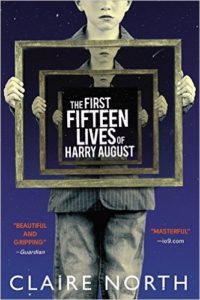
The First Fifteen Lives of Harry August by Claire North

What is it about?

The title gives away much of the plot. Harry August is a man who keeps living the same lifetime over and over again.

No matter what he does or where he goes, every death that finds him only brings him back to the day of his birth.

This isn’t to say that every single lifetime of his is exactly the same, though. He makes different choices every time that lead to happier (or sadder!) outcomes later on in life.

Why should you read it?

Reincarnation is fascinating.

I’m also intrigued by the idea of reliving your life in order to correct mistakes that you made in it. Would things be better or worse if you hypothetically took back those cruel words you spat at someone, or never travelled to the place where that awful thing happened, or ordered a salad instead of the shrimp special on your twenty-third birthday that gave you life-threatening food poisoning the last time around?
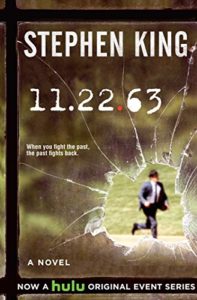
11/22/63 by Stephen King

What is it about?

A high school English teacher named Jake who travels back through time to attempt to stop the assassination of President Kennedy.

Like The First Fifteen Lives of Harry August, trying the change the past is much harder than it looks. Every time Jake changes one thing, the universe does its best to thwart him and restore time to the way it originally was.

Why should you check it out?

This isn’t your typical Stephen King tale. There are no monsters, demons, or gory plot twists. As much as I occasionally enjoy his pulpier work, this is a wonderfully mature and complex story that I’d recommend to people regardless of whether or not they’re already a fan of this author’s writing style.

This is one of those rare cases where I’d recommended watching the TV show by the same name just as much as I’d recommended reading it.

Is it cheating to admit that I’m not entirely sure I finished the book when I tried it a few years ago?  It’s been so long ago that I can’t remember for sure, but I love the TV show so much that I’m now planning to give the original story another try. Sometimes it takes me a few tries to read all the way through a full-length novel, and there’s nothing wrong with that.

This is the kind of story that excels on the small screen because of how much it depends on small details. In this case, visualizing those little details was much easier for me to do by watching it unfold one episode at a time. You may want to try both and see which one appeals to you most.

Happy reading!
Comments Off on 5 More Modern Scifi Books You Should Be Reading

Filed under Science Fiction and Fantasy

How to Survive a Post-Apocalyptic Storyline

Congratulations!

You’ve just been selected to be one of the secondary characters in an upcoming post-apocalyptic novel.

If you wish to die nobly in order to spur the main character on at a critical moment in the plot, please disregard the rest of this message. There is always a need for volunteers for this position, and so your sacrifice in this manner will be greatly appreciated by everyone who expects this kind of tearjerking moment in a world without any modern conveniences.

If you want to live, memorize these rules and be sure to follow them religiously once the first scene has begun. They won’t guarantee your survival, but they will greatly increase the odds of it.

  1. Ignore the news and the government. There has never been one single instance of a government body or a news organization having any clue what is really going on in an apocalypse. Do not listen to any advice they give, and avoid traveling to any safe area they recommend in the first few scenes. It will be a trap.
  2. If the protagonist travels east, head west. While this isn’t always something that’s possible to accomplish, staying out of the way as much as possible is the safest thing you can do until or unless you are promoted to a main character role. Every big battle will take place wherever the main character roams, so you will reduce your chances of getting caught up in one if you travel anywhere other than those locations. This rule can be broken during the climax if other secondary characters have already been killed off and if you are willing to take the risk that the author still has some tricks up his or her sleeve.
  3. Do not endear yourself to the audience. You will feel tempted at times to play up the best parts of your personality in order to lure some of the audience’s attention from the main characters, but encouraging them to love you will only increase the odds of you succumbing to whoever or whatever it is in the storyline that has killed off so many other people before you. This is especially true if you are young, vulnerable, or happen to remind the protagonist of a loved one that he or she left behind in the beginning of the story.
  4. Avoid playing the hero. If you know your safe house is surrounded by monsters, avoid any foolhardy attempts to sneak past them regardless of who in your party might be in dire need of medicine, food, or water in that scene. There is only one hero in this story, and any attempts to steal that spotlight will be interpreted by the writer as foreshadowing for your eventual death. Stay in the shadows and away from the dangers of sudden plot twists as much as possible while the keyboard is still clicking away.
  5. Remain slightly hopeful. Characters who lose all of their hope for the future are in just as much danger as characters who are still obnoxiously cheerful and upbeat after days of hiking through the mud and shivering the night away without a single blanket to keep them warm. Stay neutral when the dialogue is not focused on you and slightly hopeful but still realistic about the odds if you happen to get accidentally caught in the same scene with the main character after the opening act.
  6. Memorize the most common kinds of creatures found in the science fiction and fantasy genres. Elves and faeries are almost always trustworthy. Unicorns are harmless to non-virgin humans. Ghosts may be frightening, but they are rarely a genuine threat to anyone. Orcs, zombies, vampires, and goblins are always dangerous unless you happen to wind up in a rare post-apocalyptic romance novel where a member of their species happens to be the main character’s love interest. Once you know who or what you’re dealing with, you’ll know whether to stick with, tolerate, or avoid any non-human characters that may be lurking in the book.
  7. Listen to your elders. While not every post-apocalyptic story will include an older, wiser character who knows exactly what is going on, be sure to listen to them if they appear at any point in the storyline. The chances of that individual guiding you safely to the final scene are much higher than you might think.  People like this usually appear in the plot for a good reason and should be trusted unless you have an even stronger reason to ignore their sensible advice. In some cases, this can even shorten a full-length novel into a tidy short story with only a small reduction in the overall suspense and excitement of the tale.

With any luck, following all of these rules will help you survive until the final battle. Every character is more or less on their own at that point, so be sure to continue practicing your swordsmanship, long distance running, emergency medical drills, and spell casting until you know exactly what kind of book you will be assigned to and therefore what skills you will need to survive whatever disease, monster, battle, natural disaster, or other source of conflict may be coming your way.

Newer posts in this series:

How to Survive a Paranormal Storyline.

Comments Off on How to Survive a Post-Apocalyptic Storyline

Filed under Science Fiction and Fantasy, Writing

Suggestion Saturday: February 18, 2017

Here is this week’s list of comic strips, confessions, and other links from my favourite corners of the web.
What Aliens Really Want with Humans.  If any aliens read this, I would gladly sign up for this sort of arrangement if I can bring my spouse and some other family members.

Shakespeare in the Bush. In 1966 an American anthropologist attempted to tell the story of Hamlet to the Tiv in West Africa. How well does Shakespeare’s work translate in a culture where leaders always have multiple wives, nobody knows what a ghost is, and witches are the source of a lot of people’s woes? You’ll have to keep reading to find out.

Telling Family the Childfree Choice via WriterDann. This was very good advice.

Netflix Cheating: Your Significant Other Is Probably Stepping Out on Your Joint Viewing. I’ve never done this to my spouse, but the title of this post alone was enough to make me recommend it. What a funny dilemma to have.

Thanks to Tumblr, I’m Genderqueer via tmamone. Trav has taught me so much about gender identity and how complex it can be for some people. This is an article they wrote recently about their experiences. I highly recommend checking it out.

From Rescue via BodyofBreen:

Yesterday, as I walked past the lighthouse and on toward the Boardwalk, a young man rushed past me, vaulted a fence, and, while standing at the cliff’s edge, shouted “Someone’s struggling. Help her!”

In the water below, a young woman was treading water dangerously close to the cliff face.

From Raising the American Weakling:

When she was a practicing occupational therapist, Elizabeth Fain started noticing something odd in her clinic: Her patients were weak. More specifically, their grip strengths, recorded via a hand-held dynamometer, were “not anywhere close to the norms” that had been established back in the 1980s.

Comments Off on Suggestion Saturday: February 18, 2017

Filed under Suggestion Saturday