
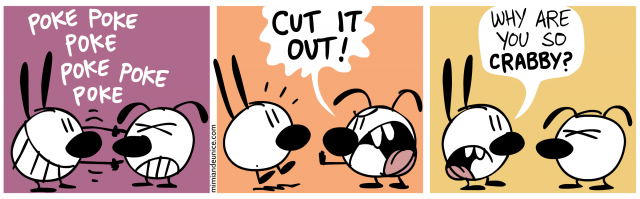
Why Are You So Crabby?

Some fairly serious posts are tentatively scheduled for next week. In the meantime I’d like to dissect this strip from one of my favourite web comics, Mimi and Eunice.

It is one of the few items on my RSS feed that made me cringe-fully laugh out loud this week. When I was a kid I used to subtly irritate my brothers until they reacted. As far as I can recall it was never anything cruel or painful – just standard sibling teasing. When they retaliated mom and dad would often blame them for instigating the entire thing.

I don’t remember why I did those things. Maybe they had teased me earlier,  maybe I thought it was funny or it might have just been a bizarre developmental phase. When my youngest brother finished high school I apologized to them for being sneaky and annoying. Despite the decade or so that had passed since we’d stopped interacting in those ways I still felt a touch of guilt for my part in it.

Why do adults act like this? We (typically) don’t physically jab one another with our fingers but I’ve seen more than one person a few decades removed from elementary school draw out the same reactions in others with a sharp word or aggressive body language. Every time it happens I wish I could temporarily re-write the rules of polite behaviour so I could ask what was happening in his or her life that made it seem ok to agitate someone else like this.

Is someone else poking their buttons? Have they had a horrible day, month, year and are running dangerously low on compassion? Do they enjoy introducing more pain into the lives of others? Why play innocent when the other person finally reacts? Have they missed social cues and don’t realize what they did?

I also wonder why more of the Eunices of the world don’t climb out of their comic strips. Sometimes this isn’t possible, of course, but if I was in her cartoon feet I would have disappeared halfway through the first panel. When Mimi was ready to apologize and stop poking me I’d come back and forgive her…but not before then.


7 Comments

Filed under Uncategorised

Choosing Friends, Choosing Enemies

This post is a response to Why Not Want to Like? Ever since this short poem was posted last week I’ve been mulling over why we like some people and dislike others. From the link:

Why wouldn’t I want to try to like everybody I meet?

This isn’t something I’ve discussed here before but everyone has what I can best describe as their own flavour, scent or musical note. That is, each of us has a unique combination of personality traits, general interests, character, beliefs and outlook on life. Sometimes there’s an automatic sense of compatibility when two new friends meet. At other times there isn’t and personalities clash. When this happens it doesn’t mean that one person is right and the other wrong any more than it’s right or wrong to mix musical notes or spices. Some combinations work well, others won’t.

Liking someone in a platonic way has two different meanings to me: one has to do with how one acts, the other with how one feels.  I can treat others with kindness, courtesy and respect but I cannot  sit down one day and decide, “I’m going to enjoy person X’s company this afternoon” or “person Y is my closest friend starting…now.” My brain just doesn’t work that way. Relationships tend to have lives of their own and I’ve been surprised more than once by who has and has not become a good friend.

So I’m going to assume that liking people in the above link refers to how we treat them. Under that assumption I completely agree with the above post. (It would be incredible if we were able to flip a brain switch and choose which emotions others stir up, though!)

What is fascinating is how much choosing to act in certain ways around others can influence what one thinks about them over time. I’ve seen people who were once defensive or angry but who chose to remain respectful and de-escalatory gradually repair unhealthy relationships. Others I’ve known have forged adamantium-strength bonds with people from such radically different paths that I never would have pictured them getting along so splendidly.

The entire topic reminds me of being told to love everyone when I was a Christian. As a child and teenager I couldn’t imagine doing this. Love was a natural outgrowth of relationships formed over many years. It wasn’t something that could be harvested and passed out to the hungry like ripe tomatoes.

Eventually someone explained that what it meant was we should be treating everyone the way we’d want our relatives to be treated by strangers, not that I literally had to love every other person in the universe as much as I did family and friends. That helped. Mostly. (What can I say? I was the sort of Christian who took these things extremely seriously!)

Respond

How do you interpret calls to “love your neighbour” or “like everyone you meet” in your daily life? Can you control whether or not you like someone? If so, will you teach me how to do it? 😛

Leave a Comment

Filed under Uncategorised

Suggestion Saturday: April 23, 2011

Here is this week’s list of blog posts, interviews, photos and other tidbits from my favourite corners of the web.

Sun and the Moon. There’s something in this photo that I didn’t notice the first time I viewed it. Can you figure out what it is? The answer is in the text at the bottom of the link if you need help.

Zombie Boy. What stood out to me the most about this interview was how much the man who is covered in tattoos that make him look like a rotting corpse changed when the people around him began treating him with kindness and curiosity. It was not the reaction he expected!

Honest Logos. I didn’t understand all of these logos. Do you? I will say, though, that the ones I did figure out are far more entertaining to look at than the real logos they’re mocking.

Global Warming Solutions Mind Map. These are all great habits to acquire but I can’t help wondering if it would actually make a big difference even  if we could convince every household to cooperate. From what I’ve read most pollution either comes from corporations or is a result of our infrastructure. (I could be wrong about that.)

What I’m reading: Jodi Picoult’s Sing You Home. It’s about a divorced couple who goes to court to determine if one of them is allowed to use their frozen embryos to have a child when the other vehemently disagrees with that plan. Fascinating stuff.

Is this photo as mesmerizing for you as it is for me? I wish I could paddle into it and see what is hidden behind the fog.

What have you been reading?


4 Comments

Filed under Uncategorised

A Review of Fall to Grace

Jay Bakker’s new book Fall to Grace: A Revolution of God, Self and Society explores the meaning of grace and how to live out the idea that God loves us unconditionally.

For anyone who isn’t familiar with what Christians mean by the word grace: think of it as being loved, honoured and favoured by someone without doing anything to make them feel that way about you. Usually, but not always, that someone is God.

To be honest I spent the first half of this book waiting for the other shoe to drop. I’ve known more than one Christian who segues from talking about the gift of grace to sharing their list of rules that need to be followed in order to keep it. Jay never does this which was intriguing and surprising.

The best part of the book by far were the grace notes, interludes written by people Jay knows who have lived through difficult experiences.  True stories have always been my favourite part of reading books about theology or ethics. There is something about learning what another human being has been through and what he or she has discovered as a result that is a thousand times more informative and instructive than reading a hundred pages of even the most well-written ideas.

This book focuses heavily on the application of grace as it is related to one particular issue. I would have preferred to hear how Jay’s ideas about grace impact his reaction on a wider variety of topics. Too often conversations about grace whittles down to the same subjects over and over again and his message would have been been more effective had its arguments drawn from multiple examples.

I’d recommend this book for Christians who are interested in taking a second look at how they think about God and live out their beliefs. Most of the arguments and Bible stories that are used as examples in this can be easily understood by someone who isn’t already familiar with them but it isn’t written specifically for non-Christians. It’s sort of like visiting a family in the middle of a (good-natured) debate. Those of us outside of the family listen to various points of view but we don’t have a personal stake in how it is all sorted out.

Note: I received this book for free through the viral blogging program at www.theooze.com.


1 Comment

Filed under Uncategorised

Play: It’s Not Just for Kids

Each of the following items is interactive in some way. It’s up to you to figure out how they work.

Have you figured out how each one works yet? If you’re stuck click here. It’s also a good link to explore if you’re looking for similar games. The man who creates them has a fascinating site!

Play

The mechanics of playing has been on my mind recently. Every child I’ve ever met has been interested in some sort of imaginative or creative play and many of my adult friends continue to experience our world with fresh eyes.

I think the Internet is like an adult version of a playground or park. There are many different activities going on at once and one can usually jump easily from one game to the next. It’s also something that we spend time on because it’s entertaining. Some people earn a living online but this doesn’t seem to be the motivation of most.

If only the Internet could somehow include a real sandbox and swing set, though! Those were my two favourite parts of going to the park as a kid. (And as an adult. 😉 )

Why do we play? It’s fun. Sometimes it helps us express emotions or ideas that are difficult to draw out in more grown-up ways like writing or talking. Everyone has a story to tell.

Why do some people stop playing? I wish I knew.

How would you answer these questions?


Leave a Comment

Filed under Uncategorised

Suggestion Saturday: April 16, 2011

Here is this week’s list of blog posts, short stories, videos and other tidbits from my favourite corners of the web.

Gee Whiz. I’m not usually into love songs but this one was worth watching.

Hwang’s Billion Brilliant Daughters. This stirs up emotions that haven’t been named yet.

Valhal-Mart. What would happen if toy stores began selling action figures based on your deity? The author of this post explains his mixture of emotions so transparently that it is as if you and I are standing in the toy aisle next to him. I had no idea, though, that anyone still worshipped Thor.

Hobbit Houses. If I ever become incurably wealthy I’m going to build a cozy village of hobbit houses out in the country. You’re welcome to join me! 🙂

Guide to Laundry Symbols. One of the funniest and most creative interpretations of common symbolsI’ve seen in a long time. It’s also a good reminder to laugh. Life is too short to take everything seriously.

How society’s ideas about masculinity harm men. (Trigger warning: there is a description of gang rape about 9 minutes into the talk.)

What have you been reading?


Leave a Comment

Filed under Uncategorised

How to Discuss Politics

So, you’ve finally chosen a political party. Congratulations! Here are a few things to remember as your country prepares for the upcoming election:

1) God is on your side.

2) There’s no such thing as common ground. Either they have the unvarnished truth or you do.

3) Except when it comes to atheists and agnostics. Everybody knows that it’s impossible to be a moral, upstanding citizen without god.

4) The best way to convince others to agree with you is to start a heated political debate every time you see them. Don’t worry if they start changing the topic or asking you to talk about other things instead. This simply means they’ve realized that you’re right.

5) The best way to win political and religious converts is by insisting that the country cannot be governed properly without consulting your holy book. The more you intertwine the two the more both appeal to those with other beliefs.

6) When in doubt assume the worst-case scenario if one of their people is elected and the best case if one of your own wins.

7) You can tell how qualified and trustworthy a candidate is by how closely his or her religious beliefs match your own

8 ) Don’t waste time learning about the political systems of other countries or how the decisions made by your leaders may affect them.  If possible, refuse to learn even the names of their leaders or the outcomes of their elections. Information like this only clouds your judgment and makes voting that much more difficult.

9) It’s ok to lie about what the other side says, believes or does if it furthers your cause.

10) Finally, never forget that god has a special plan for your country that can only be brought to fruition if enough people vote for your party. Anyone who votes for someone else is sending a clear message about to whom they’ve given their allegiance.


Leave a Comment

Filed under Uncategorised

Has the Internet Destroyed Our Social Skills?

Over the last week I’ve stumbled across multiple articles and blog posts that claim the Internet is destroying our social skills.

There is no denying that the Internet changed how we communicated with friends and family in faraway cities in an instant. I’ve reconnected with people I haven’t seen in person for 10 or 15 years because of email, social networking sites and search engines. So far all of the old friends and acquaintances with whom I’ve wanted to catch up have appeared online at some point. This is incredible.

The marrow of today’s discussion:

Has the Internet negatively affected our social skills?

Some of the articles I linked to earlier claim that we were kinder and  knew how to get along with one another better before people began spending so much time socializing online.

Is this true?

I was a few months shy of 16 before my family signed up for Internet access. Most of the communities we lived in during those years were small, rural and midwestern.  In my experience a small percentage of the population will always be malignantly unfriendly but most people are wonderful most of the time. This was as true 20 years ago as it was last week. The biggest difference between life before the Internet and what we have now is that it’s easier now to choose with whom we spend our time. This is a good thing. My life would have been much more difficult if I hadn’t been able to connect with like-minded people. (Living in a small town of circles can be achingly lonely when you’re a square peg!)

To be honest, though, I was so young when I first plugged in that I may not be remembering things correctly. Maybe people really were better socialized in the 90s, 80s, 70s, etc. Maybe we really are losing those skills by spending too much time online.

Respond

What was life like before you discovered the Internet? Did people as a whole have better interpersonal skills a generation ago?

Are we romanticizing the past?

(I’m particularly interesting in hearing from those of you who did not grow up with Internet access!)


13 Comments

Filed under Uncategorised

Suggestion Saturday: April 9, 2011

Here is this week’s list of blog posts, videos, comics and other tidbits from my favourite corners of the web.

The Stars Died for You. I’ve never thought about physics this way before. The last line is completely unnecessary but the clip as a whole is well worth watching.

Best Friend Injustice and the Hardships of Polygamy. The concept of having one and only one best friend is so bizarre. Yes, sometimes we grow closer to one person than we do to another. There’s nothing wrong with that. I don’t understand why there can only be one, though, or why it needs a special word to describe it. Why not let each friendship evolve naturally into the form it was meant to take?

Positive TV. What if there was a television channel dedicated to telling us that we’re wonderful?

The Changing U.S. Food Supply. If only these graphs had compared eating habits across socioeconomic lines and with the habits of similar countries (Canada, for example!). Looking at what the “average” American eats is interesting but it’s hard to place these facts in context without more information.

I just started reading Freak Angels, a free web comic about 12 teenagers living in a post-apocalyptic world.

What have you been reading?


Leave a Comment

Filed under Uncategorised

Every Mind Boggles

Today I wanted to talk about a few things that boggle my mind.

Thing One

The Land of Painted Caves was released last week. I’ve been reading and rereading this series for over 15 years and am looking forward to it finally being wrapped up.

What originally drew me into the story was its exploration of the tension between personal autonomy and belonging to a community. Being part of a group requires certain compromises over time. Some are mild, others utterly life-changing.

I wonder, though, if someone born and raised in a collectivistic society would struggle with this the way those of us who live in individualistic cultures do at times? My best guess: no.

It’s impossible to think about this without applying my cultural conditioning or values to it, though. I can’t imagine what it would be like to spend an entire lifetime believing that the common good or the needs of the group were always more important than what I wanted or needed.

(This does not mean that I think there’s anything wrong with collectivist societies. It’s simply so far removed from how I grew up that my brain struggles to understand the how and why of what they value most.)

Thing Two

If one wants to make wisecracks about his or her own disability, rape, impending death or how he or she narrowly escaped the latest natural disaster I’ll still fail to see the humour in it but won’t be offended.

Making fun of other people’s suffering, though, is the fastest way to enrage me (especially when object of the “joke” is someone vulnerable.)

Thing Three

Ostensibly serious news organizations that report on what celebrities are wearing, eating, saying or doing.

Respond

What boggles your mind?

Leave a Comment

Filed under Uncategorised