Tag Archives: Book Reviews

An Imperfect Crime: A Review of The Ghosts Inside

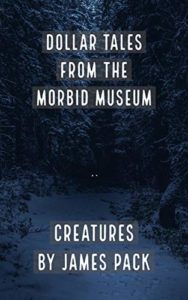
Dollar Tales from The Morbid Museum: The Ghosts Inside book cover. There is a fuzzy photo of an amphibious, bidedal creature on this cover. Title: Dollar Tales from The Morbid Museum: The Ghosts Inside

Author: James Pack

Publisher: VaudVil

Publication Date: 2019

Genres: Science Fiction, Horror, Contemporary

Length: 40 pages

Source: I received a free copy from James

Rating: 3.5 Stars

Blurb:

These Dollar Tales feature one or two short stories from the forthcoming collection of fiction by James Pack titled Morbid Museum. This Dollar Tale is called The Ghosts Inside and features the original and extended versions of the story. Go inside the mind of a man who believes he is saving children by ending their lives. Will he kill again or will someone stop him from taking young lives?

Review:

Content warning: child abuse and the murders of children. I will not be discussing these things in my review.

This e-book contains two versions of the same tale. I found the first draft too short for my preferences, so I’ll be reviewing the extended version.

Not every serial killer is an evil genius.

One of the things I liked the most about this story was the fact that the antagonist behaved like an ordinary person. (Well, other than the murders he committed, of course). He wasn’t the strongest, smartest, fastest, or most cunning person around. If not for his awful hobby, he would have struck me as a perfectly average man. That was refreshing.

I found it tricky to keep up with the multiple narrators. It would have worked really nicely in a novella or novel, but the roughly twenty-five pages that the extended version had to work with simply wasn’t enough space for everyone to show the audience who they were and what they were about. Focusing so intently on the killer in the first version was a smarter decision. As much as I enjoyed many of the other changes the author made to the storyline once it was expanded, I do wish this part of it had carried through.

There were so many hints about the killer’s personality that I was able to gently tease out of the things he said and did. It was interesting to figure out what made him tick. While he wasn’t someone I’d ever want to meet on a dark street or anywhere else, I did like the way the author tried to explain why someone would commit such unforgivable crimes. This only became more true as I realized what the killer’s biggest weakness was and why it appeared to be something that he himself wasn’t necessarily aware of. I’ll leave it up to other readers to put these pieces together for themselves, but they did make for a satisfying experience.

Dollar Tales from The Morbid Museum: The Ghosts Inside was much darker than what I typically read. I think it would be best suited for people who enjoy crime fiction or dark science fiction.

2 Comments

Filed under Science Fiction and Fantasy

Surviving the Apocalypse: A Review of Patient Zero

Patient Zero Post Apocalyptic Short Stories book cover. There is a biohazard sign on the cover as well.Title: Patient Zero: Post-Apocalyptic Short Stories (Project Renova #0.5)

Author: Terry Tyler

Publisher: Self-Published

Publication Date: 2017

Genres: Science Fiction, Post-Apocalyptic

Length: 120 pages

Source: I received a free copy from Terry

Rating: 4 Stars

Blurb:

The year is 2024.
A mysterious virus rages around the UK.
Within days, ‘bat fever’ is out of control.
Patient Zero is a collection of nine short stories featuring characters from the post apocalyptic Project Renova series. All stories are completely ‘stand alone’.

1. Jared: The Spare Vial
Jared has two vaccinations against the deadly virus: one for him, one for a friend…

2. Flora: Princess Snowflake
The girl with the perfect life, who believes in her father, the government, Christian charity and happy endings.

3. Jeff: The Prepper
What does a doomsday ‘prepper’ do when there is nothing left to prepare for?

4. Karen: Atonement
She ruined her sister’s last day on earth, and for this she must do penance.

5. Aaron: #NewWorldProblems
Aaron can’t believe his luck; he appears to be immune. But his problems are far from over.

6. Ruby: Money To Burn
Eager to escape from her drug dealer boyfriend’s lifestyle, Ruby sets off with a bag filled with cash.

7. Meg: The Prison Guard’s Wife
Meg waits for her husband to arrive home from work. And waits…

8. Evie: Patient Zero
Boyfriend Nick neglects her. This Sunday will be the last time she puts up with it. The very last time.

9. Martin: This Life
Life after life has taught the sixty year old journalist to see the bigger picture.

Review

Review:

Content warning: death. This will otherwise be a spoiler-free post.

It’s impossible to get away from an invisible foe that has spread everywhere.

Normally, I pick about three short stories in an anthology and do mini-review for all of them. This time I decided to shake things up since everything in this collection has the same setting. The characters change, but the effects of the Kerivoula Lanosa (bat fever) virus are felt by everyone in this world.

The character development was well done across the board. Each character had a limited amount of time to show the audience who he or she was due to how everything was formatted, so I was impressed by how well I got to know everyone. Their unique personalities shone through no matter how many or how few pages they had to share their experiences. While I can’t say that I’d necessarily want to be buddies with everyone in this universe, I did want to learn more about all of them. They were all genuinely interesting folks, and that’s something I always love discovering in a book.

While I didn’t expect to have every question of mine answered neatly, especially since I haven’t read the rest of this series yet, I would have liked to see a little more attention paid to the final story. Martin: This Life had a tone that was nothing like anything else I’d read earlier. It also introduced a plot twist that had not been so much as hinted at in any of the other stories. In fact, it seemed to change the genre classification entirely. I was intrigued by this surprise, but I also wish it had been explained a little better.

With that being said, I still enjoyed this collection and would recommend it to new and longterm fans of Ms. Tyler’s work alike. It left me with so many questions about what happened next in this universe that I can’t wait to read everything else about these characters and the plague they tried to survive.

This anthology is part of the Project Renova series, but it can be read as a standalone work.

2 Comments

Filed under Science Fiction and Fantasy

Choosing to Survive: A Review of Powdered Souls

Title: Powdered Souls, A Short Story: They Decided to Survive (Snow Sub Series Book 1)

Author: Dixon Reuel

Publisher: Self-Published

Publication Date: 2019

Genres: Science Fiction, Post-Apocalyptic, Romance

Length: 22 pages

Source: I received a free copy from Dixon

Rating: 3 Stars

Blurb: People together in close quarters – fraternization naturally follows.

A military VR trainer, wanting to keep her relationship with a fellow scientist hidden, must pass a security inspection in her lab by the vicious Atlas Crusade that has swept to power.

When the leader of the security team demands an unusual VR request in her lab, Prof. Meliss must decide between keeping her lover safe, or secretly undertaking a consciousness swap that could end the Crusade’s five-year long relentless rule. A rule that has co-opted all scientific research to aid their global expansion, rendering Prof. Meliss and Prof. Lauren expendable, as legions of other researches wait to step into their lab if either woman dishonors the great Crusade.

Science and the military aren’t always a good match for each other.

Virtual reality is one of those topics that always makes my ears perk up when I see it mentioned in a science fiction blurb. There are so many different ways to approach this idea that an author can do just about anything with it, and Ms. Reuel came up with a pretty creative take on why the military would be interested in developing a virtual world for their soldiers to explore. Their reason for paying for this research is something best discovered by readers for themselves.

The world building would have benefited from more development. I was confused by how the military seemed to simultaneously know everything that was happening in their research bases and yet also not know simple things about them like what sort of equipment they used or how their experiments were going. It’s totally possibly for a regime to act this way, but it would have been nice to know what the limits of their knowledge was.

Prof. Meliss, the main character, wasn’t given much opportunity to reveal her personality either. I’d struggle to tell you much about her as an individual or explain why she’d gotten into a relationship with her assistant, Dr. Lauren, knowing how dangerous that would be for both of them. A lot of this character development could be coming in future volumes, but it would have been helpful to have a better understanding of who she was and why they were willing to take such huge risks. I always like finding queer couples in science fiction, so I was disappointed with how their arc played out so far.

One of the few things I did learn about Prof. Meliss was that she could think quickly in a crisis. That’s the perfect skill to have when an army has descended onto your base and is breaking down the front door. The most interesting scenes in my opinion were the ones in the beginning that described how she reacted to this invasion.

Since this was both a short story and the first instalment in a series, I was definitely not expecting the character development or world building to be perfectly ironed out. But I would have liked to see at least a few sentences spent explaining how this militaristic society works, why relationships between scientists and their assistants were punished so harshly, and what the military was and wasn’t capable of. Getting thrown into a new world is amusing, but I needed more answers about what was happening before the final scene wrapped up.

With that being said, I saw a lot of promise in this tale. There were hints about how climate change had affected the lives of ordinary people in this futuristic world that I’m incredibly curious to learn more about.

Leave a Comment

Filed under Science Fiction and Fantasy

Life After The Handmaid’s Tale: A Review of The Testaments

Title: The Testaments (The Handmaid’s Tale #2)

Author: Margaret Atwood

Publisher: Nan A. Talese

Publication Date: 2019

Genres: Speculative Fiction, Dystopia

Length: 432 pages

Source: I bought it.

Rating: 4.5 Stars

Blurb: More than fifteen years after the events of The Handmaid’s Tale, the theocratic regime of the Republic of Gilead maintains its grip on power, but there are signs it is beginning to rot from within. At this crucial moment, the lives of three radically different women converge, with potentially explosive results.
 
Two have grown up as part of the first generation to come of age in the new order. The testimonies of these two young women are joined by a third voice: a woman who wields power through the ruthless accumulation and deployment of secrets.
 
As Atwood unfolds The Testaments, she opens up the innermost workings of Gilead as each woman is forced to come to terms with who she is, and how far she will go for what she believes.

Review:

Content warning: sexual assault, child abuse, torture, pregnancy, childbirth, and murder. I will only make a few vague reference to these things in my review. This will otherwise be a spoiler-free post.

Be sure to finish The Handmaid’s Tale before picking up The Testaments. I’d also recommend either watching the TV show based on this universe or doing a few hours of research on the characters, themes, and plot twists featured in the small screen version of it as well.

This is something best read by people who are intimately familiar with what has already happened in this tale, and I will be assuming that everyone who continues reading is already familiar with this universe.

I’ve included non-spoiler-y quotes from this book at key points in this review.

“You don’t believe the sky is falling until a chunk of it falls on you.”

Now that those things have been addressed, let’s jump straight into my review. I’m writing this as a hardcore fan whose expectations were sky high and who had been hotly anticipating this book. The only thing I knew going into it was that it was set long after the final scene in The Handmaid’s Tale and that it had three female narrators.

Aunt Lydia was originally introduced in the first book in this series. Her role in Gilead was to help keep the female sphere of that society running smoothly, especially when it came to training and disciplining the Handmaids. Witness 369A was a young girl who grew up in Gilead as the cherished only child of a wealthy commander and his wife. She was a true believer in her childhood faith. Finally, Daisy was a young woman who lived in Canada.

“You’d be surprised how quickly the mind goes soggy in the absence of other people. One person alone is not a full person: we exist in relation to others. I was one person: I risked becoming no person.”

My descriptions of the narrators may sound incomplete. They were written that way to purposefully avoid sharing spoilers, so be careful about what you read elsewhere online if you google them.

Gilead was a violent, abusive society wrapped in the shroud of (mostly) false piety. The Testaments went into more detail about how women were treated in many different layers of society than the novel version of the first book in this series did. Having three narrators from such different backgrounds made it easy for Ms. Atwood to explore parts of this universe that Offred couldn’t have known a thing about when she originally shared her tale.

What I found most interesting about it was how different groups of women were pitted against each other and divided into small groups: fertile women, fertile women who gave birth to living, healthy children, wives of lower-ranking Commanders, wives of higher-ranking Commanders, adoptive mothers, Marthas, Econowives, Handmaids, Aunts, and more.

“It was also shameful: when a shameful thing is done to you, the shamefulness rubs off on you. You feel dirtied.”

Everyone was competing for the same vanishingly small piece of status despite the fact that there was no safe position to take. Danger lurked everywhere no matter who you were or what you did because Gilead blamed women for things they had no control over and never wanted in the first place.

Yes, this could also be interpreted as a criticism of the way women are treated in modern society. Just like The Handmaid’s Tale, the sequel is firmly inspired by and a critique of real-world events. Dystopian novels work best for me when they draw parallels between what is happening in them and what the author wants his or her readers to understand about the real world. This is something Ms. Atwood has always excelled at, and I nodded in agreement when I read the sentences that gave hints about her opinions of the current political climate in Canada, the United States, and elsewhere. They were brief and never interfered with the plot itself, but they made her position on the rights of women, LGBT+ people, and minorities unmistakeable.

The one thing I wish had been a little better explained in this story has to do with Aunt Lydia’s character development. She’s an easy character to loathe in the book and television versions of The Handmaid’s Tale. I was fascinated by the descriptions of her life before and during the rise of Gilead. There were times when I sympathized with her despite all of the horrible things she did later on in life.

“As they say, history does not repeat itself, but it rhymes.”

Finally, what surprised me the most about this book were the conclusions it made about what to do if you find yourself locked into a world that seems impossible to escape.

The Handmaid’s Tale took a fairly passive approach to this dilemma. Any shred of hope that took root there would quickly be covered up before it was trampled.

The Testaments waters that hope, fertilizes the soil, and encourages the sun to shine just enough so that hope pushes its roots into the centre of the earth and flourishes.

Yes, history sometimes rhymes. No, that doesn’t mean that we’re powerless to change how the next sentence ends.

If for no other reason, this breath of fresh air is reason enough to read it.

6 Comments

Filed under Science Fiction and Fantasy

Once Upon a Time: A Review of The Raven and Other Tales


Title: The Raven and Other Tales

Author: Joy V. Spicer

Publisher: Self-Published

Publication Date: 2019

Genres: Fantasy, Paranormal, Historical

Length: 132 pages

Source: I received a free copy from Joy

Rating: 4 Stars

Blurb: A raven appears on a cold winter’s night. An old woman helps a stranger find his way home. A young girl encounters a bad-tempered dwarf. Enter within, where magic is found alongside the ordinary, and things aren’t always what they seem. Where curiosity leads to a nightmare. Where ashes have the power to transform. And where stolen mortals are doomed to be forever lost in the forest.

Review:

This is a collection of ten short stories that are all firmly rooted in the fantasy genre. One of the coolest things Joy did with them was to briefly explain where her ideas for them came from after the conclusion of each story. I always enjoy learning where writers find inspiration for their work, so I was excited to have a sentence or two of explanation before beginning the next tale.

The most effective way I’ve found to review anthologies like this one is to pick about three of the stories in them that most accurately represent the over-arching themes and writing style in my opinion, describe their plots in a spoiler-free sentence or two, and then share my impressions of them. If any of these mini-reviews grab your attention, I’d heartily recommend checking out the whole book.

The Forest of the Others

Grace’s father and younger brother had wandered into a mysterious, forbidden forest and never come home again in “The Forest of the Others.” Three years after their disappearances, Grace ignored her mother’s warning to stay away from those trees and went into the forest to see if she could find out what happen to them.

I sure would have liked to see better communication between Grace and her mom. These woods were such an irresistible place in this universe that I think Grace would have still gone into them even if her mother had been more clear about how dangerous they were. It felt a little odd to me for someone who had already lost two relatives to what should have been an innocuous patch of land to be so vague about what she thought happened to them or why Grace should never break this rule.

This is something I’m saying as someone who loved everything else about this story. The dialogue was fresh and crisp. Grace’s character development was handled wonderfully. Her experiences in the woods made me shudder, although I’ll leave it up to future readers to discover why. The world-building was really nicely done, too, especially when it came to the mixture of emotions Grace had about the forest she wasn’t supposed to visit. All I needed was for Grace to know exactly why that area was forbidden before she decided to break that rule anyway.

Stranger at the Crossroads

Some of the tales in this collection were so short and filled with plot twists that I need to be pretty careful what I say about them for fear of wandering into spoiler territory.  “Stranger at the Crossroads” was one of them. In it, a woman who was walking down the road with her donkey met a stranger who wasn’t at all what he appeared to be.

Does this sound like a mystery or possibly something from the horror genre? Well, it wasn’t. The main character was such a brave and kind soul that her reaction to the unnerving stranger at the crossroads was as pleasantly surprising as it was creative. I enjoyed this entire anthology, but I must say that she was my favourite character of them all. I couldn’t have asked for a better protagonist on that particular day and in that specific time and place.

An Unlikely Friendship

In “An Unlikely Friendship,” a young girl named Meg met a grumpy dwarf in the middle of the woods one day while she was out searching for edible plants to feed her family. Meg’s friendship with Nev, the dwarf, was unexpected but a nice distraction from the grinding poverty she, her widowed mother, and two older sisters had struggled with for years.  Yes, this story was one of the ones mentioned in the blurb!

Meg’s personality was nicely written. She’d been taught to be kind to everyone she met. That’s a common trope in the fantasy and fairy tale genres, so I won’t go into much detail about it here. What was refreshing about this particular take on that lesson was how Meg reacted when it appeared that her kindness was not only going to be taken for granted but could very well lead her into a worse predicament than she’d been in when she was only poor and hungry.

This is the sort of twist to a genre that makes me want to come back for more.


8 Comments

Filed under Science Fiction and Fantasy

Wombs for Rent: A Review of The Farm

I’ve decided to start reviewing more books on this blog. All of the rest of the titles I’ve set aside for this purpose for the foreseeable future are indie, but I thought I’d start off with something mainstream. The star rating below is out of a possible five stars.

Title: The Farm

Author: Joanne Ramos

Publisher: Doubleday Canada

Publication Date: May 7, 2019

Genres:  Dystopian, Contemporary, and a pinch of Science Fiction

Page Count: 326 pages

Source: I borrowed it from my local library

Rating: 3 Stars


Blurb:

Nestled in New York’s Hudson Valley is a luxury retreat boasting every amenity: organic meals, personal fitness trainers, daily massages—and all of it for free. In fact, you’re paid big money to stay here—more than you’ve ever dreamed of. The catch? For nine months, you cannot leave the grounds, your movements are monitored, and you are cut off from your former life while you dedicate yourself to the task of producing the perfect baby. For someone else.

Jane, an immigrant from the Philippines, is in desperate search of a better future when she commits to being a “Host” at Golden Oaks—or the Farm, as residents call it. But now pregnant, fragile, consumed with worry for her family, Jane is determined to reconnect with her life outside. Yet she cannot leave the Farm or she will lose the life-changing fee she’ll receive on the delivery of her child.

Gripping, provocative, heartbreaking, The Farm pushes to the extremes our thinking on motherhood, money, and merit and raises crucial questions about the trade-offs women will make to fortify their futures and the futures of those they love.

Review:

The first time I heard of The Farm was a few months ago when another reviewer compared it to Margaret Atwood’s The Handmaid’s Tale, one of my all-time favourite books. As soon as I read that line, I was hooked. Like Ms. Atwood’s famous story, this one is also about fertile, generally lower-class women being used to gestate babies for the most powerful members of society.

Unlike the characters in The Handmaid’s Tale, Jane and the other surrogates chose to become impregnated. Whether they knew what they were really consenting to is something I can’t discuss much in this review without wandering into spoiler territory. Let’s just say that the glossy description of what this job was like didn’t necessarily match Jane’s actual experiences with it.

What I would have loved to see from this book were more details. The most frightening parts of it were glossed over so much that I had to make educated guesses about how they played out. While Jane’s perspective was a limited one, it was a little frustrating as a reader to get so far into the plot only to receive the same vague hints that were contained in the blurb and early chapters.

There was a satisfying payoff for a subplot involving the woman who first introduced Jane to the idea of gestating a pregnancy at The Farm. If only the other clues at the beginning were given the same treatment. Not every dystopia is necessarily going to include a government being overthrown or other major signs that a society has gone terribly wrong. I loved the more subtle approach Ms. Ramos took with the assumptions she made about how people might respond if they couldn’t find decent paying work and selling the use of their reproductive organs seemed like the best option to make some semi-quick cash. If only she’d developed these thoughts further.

With that being said, one of the things I liked the most about this storywas how realistic it was. Yes, there were little snippets of what could be interpreted as science fiction and dystopian content in it, but everything in it is either really happening in our world today or could easily occur with a few small tweaks to how science works and what society tolerates. This is the kind of soft science fiction that grabs my attention because of how close it is to our reality.

I can sleep easily at night knowing that little green men from Mars aren’t actually ever going to invade Earth. The thought that women could so easily be coerced or enslaved into producing babies for wealthy, powerful families, on the other hand, is chilling because it has happened in the past, it is currently going on in some parts of the world, and it will almost certainly occur again in the future.

That’s frightening. Despite it’s flaws, The Farm’s no-nonsense approach to this topic is why I’ll recommend it to anyone who finds the blurb interesting.

8 Comments

Filed under Science Fiction and Fantasy