Tag Archives: Canada

Sensing Something Wrong: A Review of The Wendigo

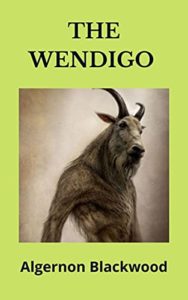
The Wendigo by Algernon Blackwood book cover. Image on cover is a drawing of a horned, hairy creature standing on it’s back feet. It looks like a large goat. Title: The Wendigo

Author: Algernon Blackwood

Publisher: Eveleigh Nash

Publication Date: 1910 (and republished on April 21, 2022)

Genres: Fantasy, Horror, Historical

Length: 74 pages

Source: I received a free copy from the author.

Rating: 5 Stars

Blurb:

Algernon Blackwood’s “The Wendigo” tells the story of a camping trip in the Canadian wilderness that goes horribly wrong when the hunters become the hunted. Drawing on the mythical creature known as the Wendigo, this story is regarded by many critics to be one of the best horror tales of all time.

Review:

Content Warning: Racism. I will discuss it in depth in my review.

Forests aren’t friendly to everyone.

Some of my favourite scenes were the ones that explored the various reactions people can have to being in the middle of the woods. What is peaceful and wholesome to one person could be mildly unsettling or even downright terrifying to another based on their previous experiences with nature and how much they know about all of the sounds that occur when one is in the middle of nowhere and can see nothing byt trees stretching out in every direction.

Horror doesn’t have to be gory or gross. There wasn’t single drop of blood in this tale, and yet it made me shudder all the same. I appreciated the slow buildup as the characters walked deeper into the woods and further away from anyone who might help them. That methodical pacing gave me plenty of opportunities to imagine what might happen next and to chew on the clues I’d already discovered. The slower and quieter scenes were exactly what the storyline needed in order to flourish. Some things are much scarier when they’ve been given time to marinate in your thoughts, and this is one of them.

I wanted to make note of the racism mentioned in the content warning. This story was written in 1910, and the author had some truly odd ideas about First Nations people and their mystical connection to nature that many white people of his era believed. In no way am I trying to excuse the offensive nature of those passages or his bizarre beliefs about how one’s race should influence what one does in the woods, only to say that the world has changed for the better since it was written and I think the author was trying to be complimentary with those descriptions based on the historical time in which he lived. While I am generally able to shake my head and ignore ridiculous stuff like this in old books, I did want to let my readers know about them in advance so you can come to your own conclusions about whether this is something you want to read.

With that being said, I loved what Mr. Blackwood did with his characters, especially Punk, a First Nations cook and guide for the group, later on in the storyline. Their character arcs were memorable and made a great deal of sense given what they found in the woods and how everyone reacted to that experience. It made me wonder what would have happened if Dr. Cathcart, the protagonist, had been more interested in cultures outside of his own. This was one of those cases where a little communication would have gone a long way, but certain cultural assumptions made that difficult. I found myself wondering how the storyline might have changed if it were instead told from the perspective of Punk after he realized that the white people he was accompanying through the woods had accidentally discovered something horrific.

The Wendigo was a delightfully chilling tale.

2 Comments

Filed under Science Fiction and Fantasy

Wednesday Weekly Blogging Challenge: What Mythological Animal You’d Want as a Pet

Hosted by Long and Short Reviews.

Click here to read everyone else’s replies to this week’s question and here to see the full list of topics for the year.

My first response to this prompt was, “none at all!”

I think I’ve read too many speculative stories about people who try to capture faeries or other magical creatures only to discover just how dangerous and foolish it is to mess with forces you don’t understand. For the sake of playing along, though, I’ll assume that any animal or creature I choose would be docile enough to make a half-decent companion, could look after itself, and wouldn’t mind if a human wanted to be near it sometimes.

An Ogopogo statue in British Columbia. It is green and grey and has parts of its body poking up from a blue stream.

An Ogopogo statue in British Columbia. Photo credit: Hamedog at the English-language Wikipedia

An Ogopogo (which is something like Canada’s version of the Loch Ness Monster) seems like a good match for these criteria.

Yes, I’d need to move to Okanagan Lake in British Columbia, but I can only assume that the Powers That Be ™ would somehow ensure that all of the details for that move would taken care of and that my new magical friend would be made aware of it. (Calling it my pet somehow doesn’t seem quite right).

Ogopogos generally leave humans alone, especially in contemporary stories about them. Mostly, they just swim around and occasionally startle tourists who weren’t expecting to see such an enormous and ancient creature calmly existing near them.

The only exception to this rule involves people who intend to harm the Ogopogo and/or the valley it protects. I would post signs warning visitors about the possibility of an Ogopogo attack if they had dishonourable intentions, but anyone who simply wanted to have a picnic or something by the lake with me shouldn’t have any trouble at all with them.

Honestly, I like the idea of a protective entity.

That’s something that many lakes and other natural places need nowadays, so I’d leave my Ogopogo do it’s sacred duty without any interruptions. If it wanted to swim up and say hello while I was enjoying the shore, so be it.

14 Comments

Filed under Blog Hops

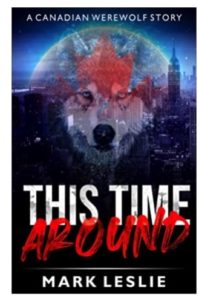
A Review of This Time Around – A Canadian Werewolf Story 
This Time Around - A Canadian Werewolf Story by Mark Leslie book cover. Image on cover shows a city skyline at night. Superimposed on that photo is a photo of a wolf's head that's superimposed on a maple leaf in front of a full moon.Title: This Time Around – A Canadian Werewolf Story
Author: Mark Leslie

Publisher: Self-Published

Publication Date: February 16, 2013

Genres: Fantasy, Contemporary

Length: 70 pages

Source: I received a free copy from the author 

Rating: 3.5 Stars

Blurb:

Caught Between the Moon and New York City 

Being a werewolf isn’t all about howling at the moon.

Or running carelessly through boundless fields feeling the wind in your fur.

Not when you live in the most populous city in the US.

For Michael Andrews, a Canadian living in Manhattan and afflicted with lycanthropy, there are odd side effects to being a werewolf in the middle of a bustling metropolis.

Such as waking up naked in Battery Park with absolutely no memory of the night before as a wolf and trying to figure out why there is a bullet hole in his leg.

Just another day in the life of a man living with the odd side effect of his werewolf affliction.

(This 10,000 word short story is the original short story written by Mark Leslie that eventually inspired the full length Mark Leslie Novel: A Canadian Werewolf in New York)

Review:

Content warning: blood and brief violence. I will briefly mention the former in my review.

If you think you know what it’s like to be a werewolf, think again. 

Humour wasn’t necessarily something I was expecting to find when I began reading about Michael’s adventures here, but it was exactly what he and I both needed. Some of the scenes were subtly humorous in ways that nodded at Canadian culture. While they certainly had universal appeal as well, it was nice to see the author acknowledge his character’s background like that. 

The only thing that held this story back from a much higher rating were the typos in it. I can ignore the occasional grammatical or punctuation error, but they happened so often here that I felt compelled to mention them. With another round of editing, this would have easily been a five-star read for me. I loved everything else about it. 

This was such a unique take on werewolves. The plot showed how Michael coped after waking up naked and covered in blood in a park after spending his night in his wolf form. Obviously, that’s not the ideal way to start anyone’s day, and somehow things only became more complicated for him from that point. I was immediately sucked into his quest for clothing and, eventually, answers about what happened to him the night before. The author went into the perfect amount of detail about what this sort of experience is like for a shifter and how many different things they must consider as soon as they revert to their human form. 

If you enjoy lycanthropy fiction, definitely do check out This Time Around – A Canadian Werewolf Story.

2 Comments

Filed under Science Fiction and Fantasy

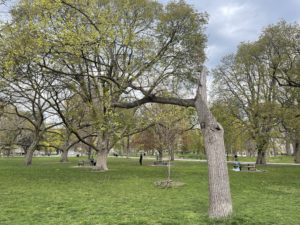
A Photo Essay Update on Damaged Toronto Trees

Last year I shared photos from one of the parks in Toronto once a month to show my readers what our landscape looks like throughout the year. This is an update to two trees in that series that were badly damaged in a winter storm in early 2020.

Click on February, MarchAprilMayJune, July, August, September, October, November, and December, and January to read the earlier posts and see what the park is like throughout the year.

Welcome back to this photo essay series! This post will be shorter than previous instalments in it since I’m only focusing on the two damaged trees that some readers requested an update on after the winter of 2020-2021 ended.

Photo of a damaged tree whose branches are curving downward.

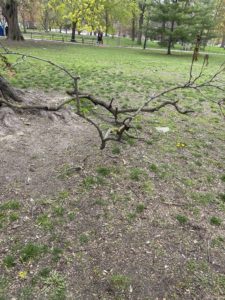
Let’s begin with the tree that lost a third of its leaves in that storm last year.

Look at how nearly all of its branches continue to bend down. You rarely see anything like that here.


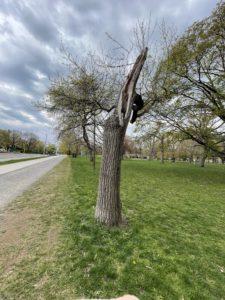
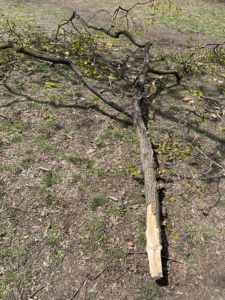
A large branch that has fallen off of a sick tree.

A week or two ago, I noticed a branch that was taller than me lying on the ground next to it. I suspect that it fell off during a recent storm due to the lack of cut marks on it and the way the bark was peeled off, but I can’t say for certain.

A large bare tree branch lying on the ground.

On a more recent visit, I saw this. I thought it was the same branch but also couldn’t confirm it.

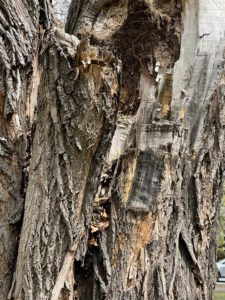
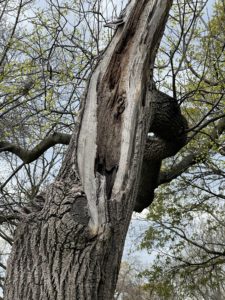
A possibly rotting trunk of a tree.

The trunk looks like it’s beginning to split open, and something appears to be growing inside of it. Maybe it’s mould or a fungus of some sort?

I worry about the survival of this tree as well as the possibility of someone getting hurt if a large branch falls on them while they’re standing near it.

Closeup of a tree that lost half of it's branches.

In happier news, the tree that originally lost half of its branches and a good chunk of its trunk is not showing any signs of mould (or whatever that stringy stuff was) growing in it. The wound on its drunk appears to be dry. There are no deep cracks in the wood, and all of it’s branches are as straight as the branches on healthy trees nearby. Landscape shot of a tree that lost half of it's branches in a storm in 2020. It's just beginning to bud again.

And to think I originally assumed this tree had been killed in that storm! Nature is full of surprises.

Side view of tree that lost half of it's branches in a 2020 storm. The branches that still remain are just beginning to sprout many new leaves.


May it stick around for many years to come.

I’ll continue to keep an eye on these trees and will provide another update in this series if either one of them experiences a dramatic change in health for the better or the worse. My hope is that any future update in this series will only contain good news, but we’ll have to see what happens.

If you’ve ever seen trees in your area go through similar injuries, I’d love to hear about your experiences there.

My reduction in blogging time will continue on for now. As much as I miss interacting with all of you more often, I’m enjoying the quieter schedule and using that writing time to focus on my speculative fiction.

6 Comments

Filed under Personal Life

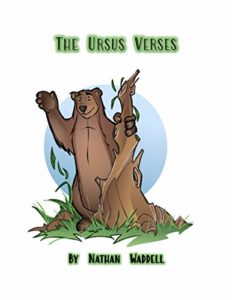
What Bears Do in the Woods: A Review of The Ursus Verses

The Ursus Versus by Nathan Waddell book cover. Image on cover is of a cartoon bear standing behind a tree stump, peeking out, and waving. Title: The Ursus Versus

Author: Nathan Waddell

Publisher: Self-Published

Publication Date: October 29, 2020

Genres: Science Fiction, Fantasy, Young Adult

Length: 66 pages

Source: I purchased it.

Rating: 5 Stars

Blurb:

Do you like bears and black holes and squid monsters and dragons and cowboy dragon slayers and riding your bike all around town looking for something to do? Because that’s what I like and this is my chapbook which captures that spirit of fun and terror and the comfort of a good fun book.
This is the first in a series of chapbooks containing poetry and flash fiction and short stories with themes ranging from those mentioned above to deeper explorations of humanity. But honestly the themes mentioned already are all about that too.

Review:

Now is the perfect time for lighthearted science fiction.

Ordinarily, I’ll pick out a few short stories, poems, or essays from collections like these and share my thoughts about them. There were so many funny themes covered here that I thought it was best to allow other readers to discover them for yourselves without spoilers, especially since the later entries often referenced earlier ones.  All you need to know is that this is heavily based on science, science fiction, fantasy, and mythology. Start at the beginning, relax, and enjoy.

This is the sort of young adult science fiction that easily crosses over into adult audiences. The humour in it is tongue-in-cheek and does rely on a certain amount of understanding of the types of scientific concepts generally taught in high school, but it explains most of them well enough to appeal to preteens who haven’t taken Biology yet or older adults who might have last thought about the Paleozoic era half a century ago. In other words, don’t spend too much time thinking about whether you’re “Young Adult” enough for this collection. If you’re interested, there will almost certainly be something here that appeals to you.

Some of my favourite sections were the ones that relied on puns and jokes. Yes, there were the usual quips about what bears do in the woods, but that was the only the beginning of the many reasons to laugh while reading this collection. Honestly, what could be better than finding the humour in speculative fiction no matter which branch of it the narrator happens to be visiting at the moment? I sure can’t think of many things.

Be sure to read the author’s explanations of why he wrote select pieces of this collection. The explanations are all located at the very end, and it was really interesting to read their backstories.

I’m looking forward to reading the rest of this series. Everything published here was first written about twenty years ago, and Mr. Waddell’s writing style has evolved quite a bit since then. If you want to follow along as he shares that journey, The Ursus Versus the perfect place to start.

Leave a Comment

Filed under Science Fiction and Fantasy

6 Toronto Urban Legends for Halloween

Since most of the people who read this site don’t live in Toronto and Halloween is my favourite holiday of the year by far, this seemed like the perfect time to share some of our spooky local urban legends.

Blurry photo taken of a moving subway trainThe Lady in Red

Lower Bay subway station was built in 1966 and shut down six months later because the Toronto Transit Commission realized that any delays at that stop would shut down our entire subway system.

A new subway station was built on top of it, and the original one is only rarely available for public viewing.

Legend has it that a woman wearing a red dress wanders around Lower Bay station, but no one knows who she is

. There are no records of accidents that might explain why this spirit spooks TTC employees and the occasional film crew that wander around down there.

We do know that this patch of land was once a Potter’s Field whose coffins were partially cleared out when the city wanted space for public transit, so she might be the ghost of someone who either had no next of kin when she died or who was abandoned by them.

The Underwater UFO Base in Lake Ontario

Multiple people have reported seeing lights shimmering over, plunging into, or leaping out of Lake Ontario. These sightings have given rise to the legend that there is an underwater UFO base located in the bottom of this lake.

Perhaps the aliens come from an aquatic planet and wouldn’t do well out here on dry land?

Nessie Lives in Lake Ontario

You’ve heard of the Loch Ness monster, right?

The Seneca First Nations tribe were the first people to record sightings of our own sea monster. As early as the 1850s, white settlers claimed to see something much bigger than the average fish swimming around in Lake Ontario as well. They described it as a blue-grey serpent that was about 50 feet long.

A Haunting at Old Finch Road

There are many different versions of this tale. They all tend agree that a girl was murdered on Old Finch Road, possibly near a bridge.

Many versions say she died on her birthday and will appear to you if you sing Happy Birthday to her because the person who murdered her wrote “Happy Birthday, Susie” on a nearby rock after killing her. (Although the victim’s name changes quite a bit depending on which version of the story you hear).

Some people have also claimed to hear screams and moans when travelling along this road.

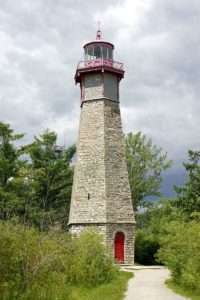
Gibraltar Point Lighthouse on Toronto Island

gibraltar point lighthouse on Toronto Island in Toronto, Ontario

Gibraltar Point Lighthouse

Mr. John Paul Rademuller was the first lighthouse keeper on this little island back when it was still a peninsula. In order to make some extra money, he was a brewer and bootlegger as well.

Legend has it that two drunken sailors came to visit him one day to buy some of his beer. When Rademuller refused to sell it to them, they killed him, dismembered his body, and buried pieces of it around the island.

In some versions of this tale, it is said that parts of him were eventually found but that his head was never recovered at all. Other versions say his ghost still continues to wander the island because his killers were never punished for their crime and not because parts of his skeleton might still be waiting to be found.

Allegedly, there were some bones found near the lighthouse in 1893, but investigators didn’t yet have the scientific tools to tell if they belonged to Mr. Rademuller or not.

Mrs. Jemima Howard’s Last Days

The unique thing about Mrs. Howard is that we have many historical records that document her life. She was the wife of John G. Howard, and they both gave the land that would later become High Park to the city of Toronto after their deaths.

Mr. and Mrs. Howard lived happily in Colborne Lodge for many years. They never had children, but they doted on their nieces and nephews who temporarily came to live with them while  finishing their educations.

Sadly, Jemima Howard was diagnosed with breast cancer long before we had any treatments for it other than morphine and laudanum for her pain. She died at home in her own bed surrounded by loved ones. If she looked out her window, she could see the spot where she (and later her husband) would be buried.

Their headstone is the only one allowed in High Park, and it’s a beautiful, peaceful spot a short distance from their home.

Some visitors to Colborne Lodge have reported seeing a woman peering out of the second story bedroom where Jemima spent her last days. Others have reported cold spots and poltergeist activity.

Maybe Jemima never left home after all.

What is your favourite urban legend from your city, town, or community?

2 Comments

Filed under Personal Life, Science Fiction and Fantasy

A Summer Without Tourists

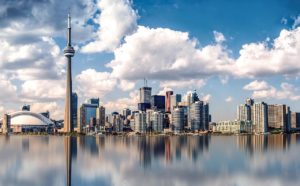
Toronto, Canada skyline. The famous CN Tower is one of the buildings in this shot. The foreground is of part of Lake Ontario There are a few things about Canadian and, more specifically, Torontonian culture that I should explain here for anyone who isn’t already familiar with them before diving into the meat of this post.
I am speaking in broad generalities here and this is a large, diverse country, so please make friendly allowances for that if your Canadian cousin/acquaintance/coworker etc. has had other experiences. There are no secret Canadian meetings where we come to a consensus on this stuff, and it’s just about impossible to get 38 million folks to agree on everything anyways.

With that being said, people make less small talk here there than do in my birth country, the United States. It’s good manners to nod and say hello to neighbours and other folks you’ve seen around before, but you generally don’t talk to strangers unless you have an excellent reason to do so.

At least in large cities here, sidewalks are serious business. Locals walk briskly and single file unless the sidewalk is large enough for larger groups to walk side-by-side. Loitering should only be done in places where you won’t slow down the flow of traffic, especially at lunchtime and in the early evening when the sidewalks are filled with nonstop crowds.

Tourists are the exceptions to these rules. If a stranger asks you for directions or advice on visiting your neighbourhood, you always stop and help them to the best of your ability. Sometimes a large group of tourists will walk slowly down the middle of the sidewalk while trying to figure out where to eat dinner or which attraction to visit next . This, too, is okay. Guests should always be treated with respect and kindness. Just turn the corner and take another street if you’re truly in a rush. If not, slow down and savour the moment.

Now that you know a little bit about how things normally function in urban Canada, let’s continue.

Toronto was eerily quiet in March and April when the Covid-19 lockdowns began. It’s slowly grown more active again as our public health agencies have given our premier permission to reopen certain businesses and relax the quarantine and physical distancing rules.

Yet this still isn’t like any July I’ve known in all my years here. Just like everywhere else, there are no tourists here.

The sidewalks by the busiest roads are beginning to fill up again, but they’re much quieter than they should be. Some streets are still completely empty even at what should be the busiest portions of the weekend.

No one has asked me about good local restaurants and whether the trendy, expensive ones are worth the money. (Some are, but most aren’t in my opinion unless you’re a diehard foodie and Instagrammer. Let me direct you to an awesome hole-in-the-wall down the street instead if what you really want is a full, happy belly).

Nobody wants to know whether they should visit the Toronto Zoo or the Royal Ontario Museum. (They’re both fun, but save the zoo for a day with nice weather when you’re not planning to do much else at all. It’s 90% outdoors, requires hours of walking to see it all, and really isn’t close to any other major attractions at all).

People don’t approach each other much at all these days. We generally keep our distance whenever possible for disease prevention reasons. With the exception of the occasional person asking for spare change, I can’t remember the last time I spoke to a stranger.

In short, it’s quiet here.

8 Comments

Filed under Personal Life

A Canada Day Like No Other

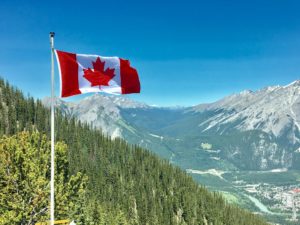
A canadian flag flying with mountains and pine forests in the background. I remember a Canada Day spent on a rooftop party hosted by a friend of a friend. The view was spectacular.


I remember a Canada Day when I felt asleep early only to be awoken by fireworks being set off nearby.

I remember a Canada Day where I took a long nap and relished that precious day off from work after several big changes there.

I remember a Canada Day that commemorated my country’s 150th birthday. It was my favourite one so far. There were massive celebrations everywhere. I spent hours listening to the live music, soaking up the happy energy of the crowds, and eating delicious treats like beaver tails (that is, the pastry and not the rodent) and seasoned french fries. That particular celebration lasted for several days instead of only one.

This Canada Day can’t be like the others for reasons all of us already know far too well.

Our government is setting up virtual celebrations for everyone so we can share joy, not germs. I hope there will be some good music to listen to and a fireworks display if possible. And I reserve the right to get a Beaver Tail later on this summer once the Canada Day lines for it are long gone.

It’s tricky enough to predict next week or next month, so who knows what will or won’t be possible next year depending on if there’s a vaccine for Covid-19 by that point. What I do know is that this year is going to be a unique one regardless of what happens in the future.

My plan is to pay attention and remember as much as I possibly can about the similarities and differences between 2020 and the years that came before it. Just like I always have a million questions about what it was like to live through any number of historical events that still remain in living memory, I suspect that future generations will have the same questions for us.

May all of their questions be answered one day. In the meantime, Happy Canada Day to all of my fellow Canadians! I hope we all find new, creative ways to enjoy this holiday this year.

2 Comments

Filed under Personal Life

Hopeful Science Fiction: Skin City

Click on the tag “hope” at this bottom of this post to read about all of my suggestions for hopeful science fiction. If you have recommendations for future instalments of this series, I’d sure like to hear them. Leave a comment below or send me message about it on Twitter.

Earlier this year I discovered the Better Worlds series, a science fiction anthology of short stories and films about hope that was published at The Verge two years ago. This is the eighth story from this anthology I’ve covered here, and I will eventually blog about all of them.

Skin City

Kelly Robson’s Skin City was about a street performer named Kass who got into trouble after falling for a radical privacy devotee.

The futuristic world Kass lives in is set about 80 years in the future in a time when climate change has become strong enough to seriously damage cities. Toronto and any other city that wished to survive had long since erected domes over themselves to keep violent, seasonal storms from flattening their historic buildings.

woman wearing virtual reality goggles

They might have looked something like this but larger.

This naturally meant that humans were crammed into much smaller spaces than many folks know in 2020.

To compensate for constantly being surrounded by strangers, some wealthy people in this universe have decided to wear a sort of electronic helmet over their head when they leave home that digitally erase other people in their line of sight and hide the owner’s facial expressions from strangers, too.

The reason why people who wore visors would want to hide their facial expressions is something best discovered by new readers for themselves. It was explained thoroughly and satisfactorily.

I enjoyed reading about these sociological and technological changes. They seemed like things that could easily happen to future generations given what life is like in 2020. I’ve known some people who gave up on social media for privacy reasons and many others who are painstakingly careful about what they post there.

Given the right technology, I can see a lot of people opting out of being seen by others, especially if they’re living in a cramped city that no longer has the resources to give people much personal space at all.

As for Kass? She wasn’t one of those folks who were wealthy enough to afford a status symbol like that by any means. Her income barely covered the necessities, and she definitely wasn’t someone who was thought of highly by the authorities. In fact, when the audience first met her she was in jail and looking at the possibility of spending the rest of her life there.  That’s the sort of detail that will keep me reading for sure!

The ending was well done, too. I would have liked to see more foreshadowing done for it so that readers would have a hint of what was to come when the earlier scenes continued to grow bleaker, but I enjoyed the twist when it was finally revealed. Honestly, it was the only logical outcome of everything that had been established about Kass and her society earlier on.

Now I know you’re all wondering how a story about a character who was incarcerated and deeply in love with someone who ordinarily would never interact with her could possibly be hopeful.

There was a time right before the final scene when I was tempted to stop reading. It didn’t seem possible for there to be a cheerful ending when Kass had so many things stacked against her pursuit of happiness.

The beautiful thing about the Better Worlds series is that it doesn’t require perfection from its characters, settings, or plot twists. In fact, some of the best stories in this online anthology so far have come from the most unlikely places in my opinion.

While this wasn’t my favourite story in this collection, it was a solid one.

Leave a Comment

Filed under Science Fiction and Fantasy

Wednesday Weekly Blogging Challenge: Books Set in Ontario

Hosted by Long and Short Reviews.

Click here to read everyone else’s replies to this week’s question and here to see the full list of topics for the year.

Most people immediately think of Toronto when they hear the word Ontario. I love my city, but today I wanted to highlight the province as a whole. There are great books set in every part of it, so I have a lot to say this week!

Wenjack by Joseph Boyden and Kent Monkman book cover. Images on cover are of common Ontario wildlife like rabbits and otters.

Wenjack by Joseph Boyden and Kent Monkman

Where It’s Set: A fictionalized version of Kenora. (If you’re not familiar with our geography, think a remote corner of Northern Ontario near Woodland Caribou Provincial Park).

What It’s About: The story of Chani Wenjack, an Ojibwe boy who ran away from a  North Ontario residential school in an attempt to go home to his family. Chani was a real child, but some parts of the plot were fictionalized.

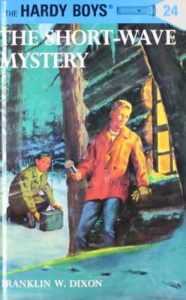
The Short-Wave Mystery (Hardy Boys, #24) by Franklin W. Dixon book cover. Image on cover is of one boy looking into a log cabin through its window while another boy crouches on the snow behind him.

The Short-Wave Mystery (Hardy Boys, #24) by Franklin W. Dixon

Where It’s Set: A fictional body of water called White Bear River near Hudson’s Bay, a real place in Northern Ontario.

What It’s About: The Hardy Boys figuring out who stole a collection of stuffed animals from an estate sale.

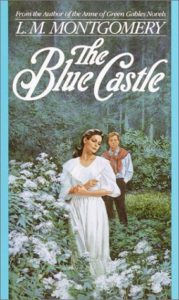
The Blue Castle by L.M. Montgomery book cover. Image on cover is of two lovers walking in a rose garden.

The Blue Castle by L.M. Montgomery

Where It’s Set: The fictional town of Deerwood, located in the Muskoka region in Central Ontario. Deerwood is based on the real city of Bala.

What It’s About: A young, single woman who was diagnosed with a fatal heart condition. Knowing that she only had about a year to live, she decided to escape her controlling family and find happiness wherever she can with the time she had left. This is my all-time favourite Montgomery novel, and it is much more cheerful than it might seem.

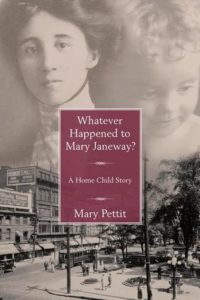
Whatever Happened to Mary Janeway?- A Home Child Story by Mary Pettit book cover. Image on cover is of a Victorian girl's photograph superimposed onto a black and white photo of London, Ontario

Whatever Happened to Mary Janeway?: A Home Child Story by Mary Pettit

Where It’s Set: Hamilton (southwest of Toronto).

What It’s About: This is a fictional story of a teenage girl who was sent to London, Ontario (which also southwest of Toronto) as part of the Home Child Program. She was so dissatisfied with her placement that she ran away from it!

If you’re not familiar with this bit of Canadian history, The Home Child program was a precursor to modern foster care and adoption in the late 1800s and early 1900s. Children in English orphanages were sent to Canada (and Australia) to be looked after by families there and taught the life skills and trades they’d need to know to be self-sufficient as adults. Some children were adopted into loving homes through it, but others were treated as free labour…or worse.

Cat's Eye  by Margaret Atwood book cover. Image on cover is of a hooded figure holding a glowing blue orb levitating above a bridge while snow falls on bare tree branches.

Cat’s Eye  by Margaret Atwood

Where It’s Set: Toronto

What It’s About: A controversial painter who returns home to confront her past and understand how those experiences shaped her art.

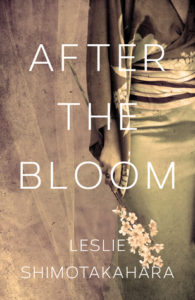
After the Bloom by Leslie Shimotakahara book cover. Image on cover is of a hand holding a branch filled with cherry blossoms.

After the Bloom by Leslie Shimotakahara

Where It’s Set: Toronto

What It’s About: An elderly woman suffering from dementia who goes missing one day, her adult daughter’s frantic search for her, and the family secrets that are revealed along the way.

38 Comments

Filed under Blog Hops