 From February of 2020 to January of 2021, I published a series of posts showing what one of Toronto’s parks looked like in every month of the year. Click on February, March, April, May, June, July, August, September, October, November, December and January to read those posts.
Two of the trees in that park had been badly damaged in an ice storm in late 2019 or early 2020, and I chronicled their response to losing branches and having their trunks damaged in my early posts. In May of 2021, I shared an update on them. One seemed to recover pretty nicely while the other was deteriorating.
I am both sorry and relieved to tell you all that as of the end of July 2022, the tree that never recovered was cut down by the city.
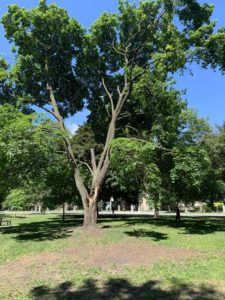
Here is a photo of that tree in June of 2020. Even from some distance away you can see the massive wound on it’s trunk from where at least one large branch was torn away. I am not a botanist or an arborist, but it otherwise looked good in 2020. It still had most of its branches, and they stood up straight and firm.
For the sake of comparison, here is a photo from May of 2020 that shows many branches it lost. I’d guess it was about a third of them.
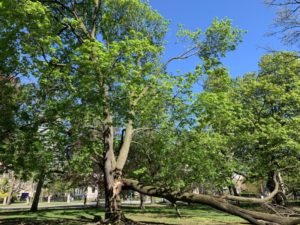
In retrospect, I wonder if the tree was sick before this storm. You often see small branches torn off during storms, but generally not such large ones in healthy specimens.
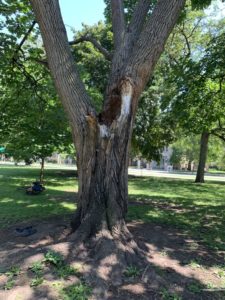
In August of 2020, a large crack began to form in the trunk.
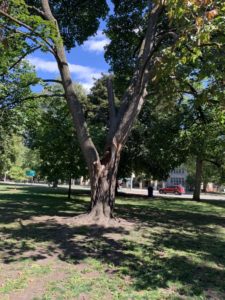
A month later, the remaining branches began to bend. I no longer felt safe walking underneath it and took all of my future photos by zooming in from a safe distance. Many of those branches were big enough to kill you if they fell on you.
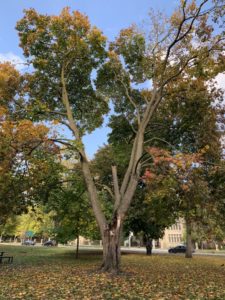
It’s hard to see in this photo, but by October of 2020 the damaged portion of the trunk began to look wet and like something stringy was growing in it. Maybe it was some sort of mould or moss? I quietly observed from a distance, but things were not looking good.
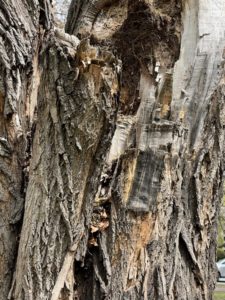
Here’s a zoomed-in photo of it from 2021. It’s hard to see, but it looked pretty bad in person.
The deterioration continued from there slowly but steadily each month.
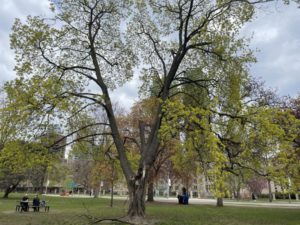
The tree did sprout new leaves in 2021, but they were noticeably more sparse than they had been in previous years. The branches began drooping more heavily as well.
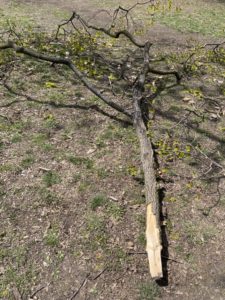
2021 was the year when branches began falling from the tree over and over again. I’d held out hope that it would recover in 2020, but by last year I was seeing more and more signs that it may not.
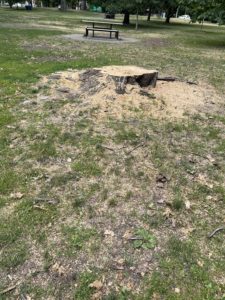
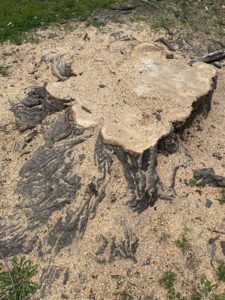
As of late last month, a stump and some sawdust is all that remains of that beautiful tree.
Yes, this was a good decision. The danger it posed to visitors to the park was growing stronger with each passing month, especially for anyone walking near it on a windy day.
With that being said, I will still miss hearing the wind rustle its branches and the shade it provided on hot days. When it was healthy, its branches were so large they even provided shade for the picnic table you can see in the distance of one of the above photos which is kind of amazing when you consider how small trees are at the beginning of their lives.
I wish it could have survived. May it Rest In Peace.

 Hosted by That Artsy Reader Girl



 One type of Canadian food I haven’t tried yet is
 For this week’s freebie/throwback theme, I’m going to share ten quotes about Canada in honour of Canada’s birthday. Many of them are humorous.
 Here are some books I’d recommend reading if you’re interested in learning more about Canadian history.
 This annual prompt continues to be a bit of a stumper as I don’t actually celebrate Thanksgiving unless you count making a fancy meal to celebrate the end of the growing season as part of this tradition!
 I stay cool during heat waves by:
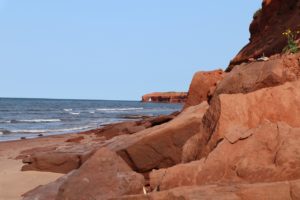
 My perfect weekend getaway would happen on Prince Edward Island.
 The possibilities are endless, and I’d relish any of them.
