Wednesday Weekly Blogging Challenge: Books I Love That Became Films or TV Shows

Hosted by Long and Short Reviews.

I recently did a Top Ten Tuesday post on a similar topic, so it’s going to be interesting to see how many other shows I can come up with. My best guess is that the first two items on my list will be on everyone else’s lists, too!

Lord of the Rings

With all of the 1980s and 1990s remakes coming out these days, I hope that this trend ends before anyone decides to remake the early 2000s Lord of the Rings films. They’ve aged wonderfully in my opinion. I’d rather see studios take a chance on something new than remake these films even though I do love this story.

Harry Potter 

There are certain things that work beautifully in a novel but won’t feel the same in a film (and vice versa). Overall, I was quite pleased with how the Harry Potter films depicted the Potterverse. The first few movies in particular will always feel magical to me.

The Martian

This film did an excellent job of explaining how the main character used science creatively to get himself out of all sorts of life-threatening predicaments when he was accidentally stranded on Mars. My first experience with Andy Weir’s style of storytelling came from this movie, and I’ve been a fan of his ever since.

Room 

Emma Donoghue’s original version of this drama about a young boy who had lived his entire life in the same room because his mother had been kidnapped by a violent stranger a few years before the boy’s birth made me stay up very late at night to see how it would turn out.

The film version of it was just as intense. Even though I already knew how it ended, I still found myself holding my breathe at certain key scenes.

Still Alice

Lisa Genova’s book by the same name was about a woman named Alice who was diagnosed with Alzheimer’s disease. I was so excited when it was turned into a film.Both versions followed Alice from shortly before she was diagnosed until well into the progression of this disease. They were tearjerkers and I’d reread/rewatch either of them in a heartbeat.

My great-grandmother had Alzheimer’s disease, so it was especially meaningful to see what this illness might be like for the person experiencing it. The gif above is from a scene where Alice forgets how to get home again early on in the course of her disease. It was the moment when I realized just how amazing this story is.

Hidden Figures

Where there were a few fictional tweaks to the film version of Hidden Figures that I wasn’t a big fan of, the true story that Margot Lee Shetterly wrote of how these women made the calculations that sent humankind to the moon is still something well worth checking out.

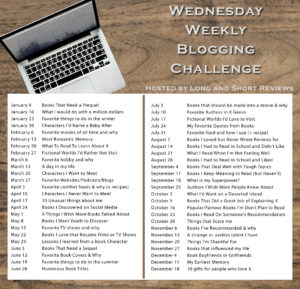
Click here to read everyone else’s replies to this week’s question. The image below is the list of upcoming prompts for this blog hop.

28 Comments

Filed under Blog Hops

Top Ten Tuesday: Favourite Places to Read

Hosted by That Artsy Reader Girl

This week’s prompt was “Books That I Refuse to Let Anyone Touch.” I was hopelessly stumped by it, so I decided to do one of the first Top Ten Tuesday prompts instead. This one is from almost a decade ago, long before I had any clue that Top Ten Tuesday even existed.

Favourite Places to Read

Underneath Trees

My family lived near a forest when I was in middle school.  Sometimes I’d ride my bike to the edge of the forest and read underneath one of the big trees just off of the official bike path. It was incredibly peaceful.

I still occasionally go to the park for this purpose today. There’s nothing like hearing leaves rustling and squirrels or other small animals chattering while you read.

On an Airplane

Flying makes me nervous, so it’s quite helpful to have a good book to distract me once the flight attendants have finished sharing the safety information they must discuss at the beginning of every flight.

I’ve actually been known to buy e-books that really catch my eye and then not read them until months later when I’m flying somewhere. It gives me something positive to look forward to during that time, and that’s always handy.

While Waiting 

I could be waiting for anything:

  • A doctor’s appointment
  • Dental treatments
  • Food at a restaurant
  • The chance to update my driver’s license

Books are a lovely and deeply-appreciated distraction in these moments…especially if the thing I’m waiting for carries the possibility of bad news!

When I Can’t Sleep

Occasionally, my brain decides to wake me up in the middle of the night for no reason. I’m simply wide awake at a time when I should be fast asleep on those nights.

It’s been my experience that the quickest way to get back to sleep is to read for a little while. Preferably, it should be something soothing, not exciting.

What are your favourite places to read? Did anyone else struggle with the original prompt for this week?


73 Comments

Filed under Blog Hops

What to Read If You Liked The Walking Dead

Since the first post in this series was about a book published almost forty years ago, I thought the second post should feature something more contemporary from the speculative fiction genre.

I try not to make assumptions about what my followers already know about any book or graphic novel I blog about, so I’ll summarize The Walking Dead in one spoiler-free sentence for anyone who isn’t familiar with it:

After waking up from a coma, a police officer must find his missing family and adjust to a world that has somehow become overrun with zombies while he was unconscious. 

Obviously, there’s a lot more going on this world, but that sentence will give you the gist of it.

As a fair warning, the graphic novels as well as the TV show based on them are both incredibly violent. I actually had to stop reading and watching both of them a while ago due to this, although I’m still intrigued by the characters Robert Kirkman first created in 2003 and the assumptions he made about what life would be like in this sort of world.

If zombies and post-apocalyptic worlds are things you enjoy reading about, here are some other books that might be equally appealing.

Some of these titles have popped up in many similar lists online, but I’ve come up with a few classic novels I thought would work as well because of how many themes they share with this series.

Humans have dealt with plagues for millennia. For most of that time, we didn’t know why someone would seem to be perfectly healthy one day only to become dangerously ill the next.  You might be surprised to see how many similarities there are between an outbreak of cholera or rabies and a zombie infestation.

What happens when a society breaks down is another string connecting all of these recommendations. While I tend to have a much more optimistic view of how the average person would behave in that situation, not every writer agrees with that. It’s always interesting to see more pessimistic takes on the topic.

The Road by Cormac McCarthy

Imagine trying to stay alive in a world where nothing grew anymore. Now picture doing it while raising a child by yourself.

The relationship between the main character and his son reminded me a lot of how Rick Grimes interacted with his son in The Walking Dead. Both of these parents had been pushed to their limits by worlds they couldn’t possibly have predicted or prevented. Their love for their children was what kept them going in impossible situations.

Fair warning: this is a pretty violent story. Be sure to read some full reviews of it before checking it out if you’re sensitive to or triggered by acts of violence.

Lord of the Flies by William Golding

In this tale, a group of schoolboys were stranded on a deserted island after a plane crash. They needed to figure out how to survive there without any adult supervision for a long period of time.

This was one of the first classics I thought about after I discovered the zombie genre. True, there weren’t any monsters on the island, but the unstable, dangerous community these kids developed reminded me a lot of how many living characters behave in typical zombie movies.

If only William Golding were still alive. I’d sure like to see what he thought of the similarities between this book and today’s horror movies.

World War Z: An Oral History of the Zombie War by Max Brooks

Zombies attacked. Humans fought back. Eventually, society stabilized enough for researchers to begin collecting stories from the survivors of this apocalypse.

I liked this more hopeful approach to how people might respond to a zombie invasion. People banded together in many of the anecdotes the narrator collected, and not all of them were the folks you might necessarily expect to make alliances with one another. Some characters also survived circumstances that seemed like they should never have worked out okay in the end. It wasn’t all doom and gloom.

Oh, and do not watch the film based on this book. The only things it shared in common with the original version were the title and the fact that zombies exist in both universes.

Yes, I might still be a little vexed about that.

Rabid: A Cultural History of the World’s Most Diabolical Virus by Bill Wasik, Monica Murphy

If you think about it, rabies shares many similarities with whatever virus, bacteria, plot hole, or magical disease that creates zombies depending on which universe we’re talking about.

This disease is spread through bites and scratches.

Once symptoms appear, death is certain.

People and animals unlucky enough to be infected with it become agitated and unpredictable.

Sometimes I wonder if rabies was one of those real-life diseases that encourages creative minds to come up with fictional versions of it. They certainly have enough in common for me to think this is a likely explanation for at least some of the zombie folklore out there.

Y: The Last Man by Brian K. Vaugh

This is one of those graphic novels that I keep waiting for Hollywood to discover and turn into a TV series. It was a post-apocalyptic story what happened to the world after a virus killed off all but one man on Earth while leaving everyone who had two X chromosomes unaffected.

It was much less violent than The Walking Dead has been so far, but humanity still had to figure out how it was going to survive in the longterm. Since even frozen sperm and male embryos died out in this plague, humanity would only continue to exist for at most another century if the characters couldn’t figure out a way to create the next generation without the help of the Y chromosome.

Most of the storyline dealt with the main character’s quest to travel to the other side of the globe and find his estranged girlfriend. That journey was far from an easy one, but it did introduce the audience to all sorts of interesting characters along the way.

The Plague by Albert Camus

This tale was written at a time when epidemics happened more often than they do in most countries today. I’ve read that Camus was influenced by the Cholera outbreaks that happened both in the setting of this novella as well as closer to home. While the storyline doesn’t mention this disease by name, it does give clues that this might be what was killing off the characters so quickly.

If you’re not familiar with Cholera, know that it’s a bacteria that causes such severe, persistent diarrhea that people die of dehydration. In short, it is an awful way to die, and the plot did go into detail about what happens to the human body after being exposed to this illness. (So maybe don’t read this while eating lunch….)

Like fictional zombie diseases, Cholera didn’t have a cure and was poorly understood. I’m not surprised Camus was inspired to write about it. It struck communities without warning and spread like wildfire through fecally contaminated water and food. Seeing how the main character reacted to an illness that no one could stop reminded me so much of Rick Grimes’ reaction to the many deaths he saw while trying to survive in a zombiepocalypse.

What other books should be added to this list? Have you read any of these titles?

Previous posts in this series:

What to Read If You Liked Clan of the Cave Bear

Leave a Comment

Filed under Uncategorised

Interview with Portia Kitcher

Portia Kitcher was the first person to respond to my speculative fiction interview post. I’m excited to kick this series off with her responses! 

Image credit: Arthur Rackham.What was the first speculative story you ever remember reading?

Grimms Fairy tales – being read to at first and then reading them myself – over and over!

Who is your favourite author? Why?

Justin Gustainis. I like him because he writes characters I like and care about. His Occult Crime series combines my two favourite genres of fantasy and crime solving.

What do you like most about the genre(s) you read?

Good guys vs. bad guys with the good guys generally winning.

More and more authors seem to be writing cross-genre stories these days. How do you feel about this trend?

That depends – I don’t like a lot of romance in my books – always keen to get back to the action, but I do like it when magic/occult combines with crime.

If you could name a pet after one character, which character would you choose? Why?

Yoda – because he is wise and small.  I am small and aspire to be wise.

What fictional world would you never want to visit?

Wonderland.

What fictional world would you want to visit?

Middle Earth.

Sharing spoilers with people who haven’t read the book or seen the film/show is a hot topic on Twitter and across many fandoms. How do you feel about sharing or overhearing spoilers?

I personally wouldn’t read the end of a book first so I don’t want to read spoilers, and don’t really understand why people do.

Which series do you think should be made into a TV show or film next?

Justin Gustainis Occult crimes series.

Which TV show or film do you think should be turned into a book?

Interesting question – I would watch a film/TV show of a book I had read but not the other way around.

About Portia: My plans to become a doctor were change due to family circumstances at the age of 17 when I left college and started work as a laboratory technician.  I got married at 18 had my two children, then went back to work 15 years later as a science technician in a school.  I then worked in Social Services as an administration officer for a supported employment agency.

I am now at home with my retired (second) husband.   I am an amateur musician and classical singer and also make celebration cakes.  I am currently doing a project where I am donating 60 of my hours to good causes.

https://thegiftoftime.home.blog/

2 Comments

Filed under Interviews

Wednesday Weekly Blogging Challenge: Favorite TV Shows and Why

Hosted by Long and Short Reviews.

I wish this prompt had happened in January or July! I tend to watch lots of TV when the weather is freezing or unbearably hot. Spring and fall are when I cut back on shows and spend more time socializing with friends and visiting the great outdoors to soak up the mild weather.  With that being said, I will follow the prompt and talk about television instead of going off on a tangent about how much I want to go wander off into the woods for an afternoon.

These are my current favourite shows for reasons I’ll explain underneath the photo of each program.  If I were going to go out to dinner with any of you, I’d light up if you mentioned being fans of them as well.

The Handmaid’s Tale isn’t on this list because it won’t be out until later on this summer. Mindfulness is important to me, so I’m doing my best to wait until the first episode is out before getting excited about it.

Anne with an E

One of the things that always bothered me a little bit about L.M. Montgomery’s  Anne of Green Gables series was how much it brushed over Anne’s difficult childhood. She mentioned some pretty serious moments of child abuse and neglect to her new foster parents, and then the plot pretty much skipped over the trauma of those experiences for her. To be fair, these weren’t things that were discussed in too much depth in children’s books back then, and people living in the 1800s also had a much murkier understanding of how adverse childhood experiences could affect someone years later.

The cool thing about season one of this remake is that it hasn’t been afraid to explore how being abused, neglected, and abandoned by multiple caregivers had a serious emotional impact on Anne. I know some fans have criticized it for being too dark, but I think it’s going to be interesting to see how this more realistic approach to her story affects the person she becomes as she grows up.

I still need to watch season two. I’m so behind on shows!

Brooklyn Nine-Nine

I love the fact that this sitcom has a diverse cast but doesn’t fall back on stereotypes in order to make their jokes or explain who their characters are. All of the main characters and even some of the secondary ones are three-dimensional individuals. They feel like real people, warts and all.  It’s amazing to see how they’ve grown and changed over the years.

The running jokes are great, too. This isn’t the sort of sitcom I’d recommend watching out of order. There were things that happened in season one that are still being brought up by the characters years later.

Stranger Things

This was the show that taught me that people used to smoke everywhere and let their kids wander all over town without any supervision at all in the 1980s! Yes, I’m mostly joking there, but I was shocked by some of the cultural differences between that era and our own.

On a more serious note, I really like fantasy stories that are set in our world and feel as ordinary as possible. If not for the various supernatural stuff going on in this setting, it could have all really happened to my parents or other relatives who were teens or young adults back then. That’s quite appealing to me.

Black Mirror

I’m brand new to this show. It’s like The Twilight Zone in the sense that each episode is its own self-contained sci-fi or fantasy story. Of the few I’ve seen so far, there doesn’t seem to be crossover between any of them as far as characters or plots go.

I love the creativity of the episodes I have seen. The writers seem to take current trends and extrapolate what they might be like at a distant point in the future or in a version of earth where, say, a parent’s desire to electronically monitor her child is taken to the logical extreme.

I know I’m being vague here, but I really don’t want to give away spoilers. Let’s just say that this is a very thought-provoking program that I’m enjoying so much that I’m even willing to come home from the park early in order to watch it.

The same can be said for the rest of these shows, too. Ha!

Click here to read everyone else’s replies to this week’s question. The image below is the list of upcoming prompts for this blog hop.

22 Comments

Filed under Blog Hops

Top Ten Tuesday: Books That Became Great TV Shows

Hosted by That Artsy Reader Girl

This week’s topic was a page to screen freebie. I’ve decided to narrow down my focus to five books that were made into wonderful TV shows. I’ve left off a couple of the titles that I always discuss on this blog (*cough* The Handmaid’s Tale) so I could focus on stories I haven’t talked all of your ears off about yet.

Tomorrow’s Wednesday Weekly Blogging Challenge prompt has what turned out to be a similar theme this week, so I had to divide my answers evenly between these two hops since so many of my answers would fit into both of them. I would have otherwise written a much longer post on this topic.

The Haunting of Hill House

Based on: Shirley Jackson’s “The Haunting of Hill House

Why I loved it: Paranormal stories always grab my attention, especially if they rely on psychological horror more than jump scares. The fact that this one had so much subtle foreshadowing on top of the psychological horror made it impossible for me to stop reading or watching it.

I also enjoyed the fact that the TV version found a fresh take on the characters while still remaining true to their personalities. That isn’t an easy thing to do…especially when some of the characters were of dramatically different ages and origins in each version!

The Magicians

Based on: Lev Grossman’s Magicians series.

Why I love it: This universe feels like Harry Potter for an adult audience. I love the unpredictability of the magic in it as well as the fact that the characters deal with serious issues like drug/alcohol abuse, depression, and abortion alongside delightfully joyful moments where talking rabbits deliver important messages or centaurs randomly cross your path.

Everything else I want to say about this series is filled with spoilers, so I’ll stop talking now.

True Blood

Based on: Charlaine Harris’ Sookie Stackhouse series

Why I loved it: I spent a year of my childhood living in the south, so southern food, accents, and culture can’t help but make my ears perk up. I also enjoyed the parallels the screenwriters made between the prejudice faced by vampires and the real-life prejudice that other groups deal with every day in our world. They did a nice job of gently nudging the audience into being more accepting without ever turning their episodes into an After School Special.

The Man in the High Castle

Based on: Philip K. Dick’s “The Man in the High Castle

Why I loved it: Imagine what the world would be like if the Nazis had won World War II and taken over North America. This definitely isn’t the right thing to read or watch if you’re in the mood for something cheerful, but it is a fantastic alternate history for anyone who has ever wondered how terribly things could have turned out in a different version of Earth.

I’m actually taking a break from this show right now because of how dark and gritty it is. It’s absolutely worth watching, though, and I do hope to return to it in the near future.

Little House on the Prairie

Based on: Laura Ingalls Wilder’s Little House series

Why I loved it: This show ended before I was even born, but the stories it told are timeless. My step-grandmother taped some of the episodes on those old-fashioned VHS tapes people once had.  I used to watch those reruns in her living room while the adults chatted in another room.

It was so interesting to see how people survived in the 1800s when women cooked every meal of the day over roaring fires, antibiotics and automobiles didn’t exist, and everyone had to work under some pretty demanding (and often dangerous) conditions from sunup to sundown if there was any hope of the family making it through the winter.

This series seemed like an adventure to me when I read it as a young child. Seeing it play out on the small screen really drove home how much easier life is for us now.


138 Comments

Filed under Blog Hops

Why I’ve Decided to Start Walking to Mordor

When I was a preteen, one of my uncles gave me copies of J.R.R. Tolkien’s The Hobbit and the Lord of the Rings. I read and enjoyed The Hobbit immediately.

The Lord of the Rings trilogy took longer to get into. The vocabulary in it kept making me pause to look up words I’d never heard of before, and the pacing was slower than I was used to in the other stories I discovered at that age.

Still, reading about the roughly 3109 kilometres (1932 miles) that Frodo and Sam walked during the course of this adventure did grab my attention. I was the sort of kid who liked the outdoors in small doses before I ventured inside again to cool off and have a snack.

The thought of walking – and occasionally running –  as far as they did while being hunted down by all sorts of malevolent creatures and skipping second breakfast made me shudder.

As an adult, I wonder what it would be like to walk that distance for the sheer fun of it. There have been various points in the past when I’ve run across accounts of people who made spreadsheets that tally how far the characters walked to get to each each milestone in the plot  and when they as a fan can pretend like they’ve reached the next one based on how far they’ve walked in real life.

It was only recently that I discovered a site that keeps track of this information for you. Walk to Mordor offers free cellphone apps and also has a space on their website for people who prefer to log their miles that way instead.

The best part about this game is that it gives you notifications about what is happening in the story as the distance you’ve travelled reach specific plot points. It starts in Bag End, Frodo’s home and the opening scene for this tale, and it goes all the way through what happened in the Grey Wood after the battles had all ended. I like the thought of that.

The man who created it developed it out of his love of these books, and I’m talking about it today simply because I think it’s an incredibly cool idea that I thought some of my bookish followers who also enjoy exercising might want to check out.

As always, this blog does not feature sponsored content and I am not being compensated for this post in any way.

Why Mordor, Though?

Because it’s a challenge.

Over the past five years, I’ve been keeping track of some of my fitness-related statistics. I’ve walked an average of 9.7 kilometres (6 miles) a day since I first began recording this stuff. This includes days when I didn’t move much due to illness or injury, so that number is higher when I’m feeling well.

Weight training is my other main source of exercise. I still find it challenging, and there’s nothing I’d change about my lifting routine at the moment.

As much as I enjoy walking, it doesn’t give me that same sense of accomplishment that moving up to a heavier set of weights or noticing how my body changes when I lift weights and eat a good diet.

By no means am I bored with walking…but I do like the idea of seeing all of the distance I put in on the average day add up to something tangible.

There’s also the fact that Walking to Mordor has a definite end date. If I continue at my current pace, it will wrap up at the end of winter or beginning of spring in 2020. I like the idea of starting something new while knowing that it won’t and can’t last forever.

(Relatively) Calm Entertainment

Photo Credit: Dawn Endico

This style of storytelling appealed to me, too. I’ve been looking for a fitness app that was somehow tied to science fiction, fantasy, or speculative fiction for a while now, but I was selective about what sort of adventure I was going to be signing up for.

First of all, It needed to be something that wasn’t going to track my location in the real world or sell my personal information to other companies. There is far enough of that happening in the world as is!

I also wasn’t interested in an app that tried to get me to move faster or for longer distances because of a storyline that involved anyone being chased by zombies or other dangerous creatures.

While I can see how that would be very motivating for some players, it’s not the sort of thing that I personally find appealing. Tell me a good story, but do let me move at my own pace while everything is unfolding.

Knowing how it ends for Frodo and his many companions was yet another reason why I decided to sign up for this game. I was definitely not feeling calm the first time I read the Lord of the Rings trilogy, but there is something to be said for returning to a world you’ve visited many times before even if it’s plot isn’t exactly what most people think of as a soothing one at first glance.

I was willing to pay for what I was looking for, by the way. The fact that I found a free app that fit my criteria was icing on the cake.

Join Me

If anyone reading this wishes to friend me on Walk to Mordor, do a search for Lydia Schoch. I kept my username there simple on purpose, and I’m happy to share my journey there if we’ve talked before and you’d like to link up.

Either way, I may be blogging about this game and others like it again in the future as I move through the various scenes. The thought of turning exercise into a non-competitive game appeals to me very much!

14 Comments

Filed under Fitness

What to Read If You Liked The Clan of the Cave Bear

I’ve decided to start another series on this blog. Just like with the interviews with people who love speculative fiction that I’ll begin publishing here next week, Hopeful Science Fictionfilm reviews, Questions from the Search Engines, and Blogging Advice, this series won’t be updated on a specific schedule. Once I’ve come up with several similar titles to recommend to people who enjoyed a certain book, that post will be added to the queue.

The Clan of the Cave Bear is a prehistoric novel written by Jean M. Auel in 1980 about an orphaned human girl named Ayla who was raised by Neanderthals. It has four sequels about Ayla’s life as an adult.

Part of the reason why I picked this specific tale to start this series off with is because I’ve been getting a spike of visitors coming to this site looking for information about Auel, her characters, and whether there is going to be a TV show or movie made about  the Earth’s Children books.

No, it doesn’t look like there’s anything in the works. I’ll be the first to shout it from the rooftops if that ever changes! In the meantime, why not talk about something I enjoyed quite a bit?

The Clan of the Cave Bear is one of those stories that I’ve returned to over and over again. The plot is an intriguing blend of adventure, romance, mystery, and even a touch bit of the paranormal genre at times.

Life wasn’t exactly easy for hunter-gatherers 30,000 years ago, so there were also plenty of subplots about gathering food, making weapons, preserving medicinal herbs, and doing everything else necessary to survive the cold, long winters of an ice age.

I’ve spent years on the lookout for books that are comparable to this one and its sequels. The following list is the cream of the crop of everything I’ve read so far about Neanderthals and how they might have interacted with Homo sapiens tens of thousands of years ago or in modern times.

The Inheritors by William Golding

This was the first well-written book I discovered when I went to the library as a young teen in hopes of finding more storytellers like Jean M. Auel who had clearly done their research about life in the prehistoric era.

It was fascinating to see how Mr. Golding imagined Neanderthals might have behaved as their culture began to bump up against a stronger one. The Neanderthals in this world were caring, but they had trouble competing in a world where a more intelligent and dangerous type of human was beginning to move into their territory.  I’d argue that this twist says just as much about him and the era he lived in as it does about one of the possible reasons why this species might have gone extinct.

Ember from the Sun by Mark Canter 

I read this title soon after finding The Inheritors, and it’s something I’ve been recommending to likeminded readers for many years now. It’s by far the most science-fiction oriented part of this list because of how much time the narrator spent setting up the storyline and explaining why the things he imagined could possibly happen with the use of science instead of magic to explain them.

In short, the main character was a scientist who found the body of a frozen Neanderthal woman that was so well-preserved he actually found a viable embryo in her womb. (Yes, there was a somewhat-scientific reason why this was possible in this universe, but I can’t tell you specifics about that scene without revealing an important part of the plot).

He implanted that embryo into a human volunteer, named the resulting baby Ember, and raised her as his own. As she grew up, she began to explore her unusual past. She had many of the same questions that people who are transracially adopted have about their identity, and those questions lead to some very interesting developments in the plot that I still mull over to this day.

The Last Neanderthal by Claire Cameron

The title of this one gives away its subject matter. We know that eventually all of the Neanderthals died out (or interbred with a much larger group of humans until their genes almost completely disappeared). There are so many things that bones can’t tell us about an individual or their culture, however!

What was the life of the last obvious Neanderthal like? How were they different from us? I can tell you almost nothing about this protagonist other than the fact that I found her delightful. Everything else I want to say would wander too close to spoiler territory because of how long it took the author to explain some of her character’s most enduring traits.

There is a film by the same name that is currently in the works. I can’t figure out if it’s supposed to be based on this book. Either way, I’m tentatively hoping to review it when it comes out!

Shaman by Kim Stanley Robinson

One of the things I wish had been different about the Earth’s Children books was how far they eventually strayed away from describing all of the hard work that people needed to do in order to survive in such harsh climates. This novel always stayed true to its setting in that way. Life as a hunter-gatherer is never something that should be romanticized even if there are certain parts of it I wish I could incorporate into my own urban lifestyle!

I also loved the friendships the characters in this tale developed with Neanderthals. They worked together to survive in an unforgiving climate. As much as I respected Mr. Golding’s take on this topic, I’d like to think that the past was a cooperative place.

The Neanderthal Parallex trilogy by Robert J. Sawyer

In Hominids, the first book of this series, humans from our Earth meet a modern-day Neanderthal from a parallel universe where their species survived and humans died out tens of thousands of years ago.

The cultural differences between Neanderthals and humans were vast. To give one of the least surprising examples, all of the Neanderthals in this universe are bisexual and have two spouses, one man and one woman. It was fascinating to see how these two worlds collided once the characters realized just how many assumptions they made about life didn’t fit the other society in any way.

I can’t believe no one has turned this into a TV series yet. Robert J. Sawyer has written dozens of worthwhile books, but this world in particular really needs to be shared with a wider audience. It was so thought provoking.

Respond

If any of you have recommendations for other prehistoric tales or a request for a book I should feature next in this series, do speak up. I’m always open to suggestions.

24 Comments

Filed under Science Fiction and Fantasy

Wednesday Weekly Blogging Challenge: Books I Want Youth to Discover

Hosted by Long and Short Reviews.

I’d never tell a kid that they must read a specific book. Just because a story was meaningful to me at a certain age doesn’t mean every child or teenager would want to read it then. People grow at different rates, and we obviously all have different interests as well.

What I would do is leave copies of these books lying around where little, and not-so-little, hands can reach them. My hope would be that young people would eventually read these titles whenever they were ready for them.

The Little Prince by Antoine de Saint-Exupéry

The full meaning of this story didn’t become clear to me until I was an adult, but I think it’s message about valuing love, friendship, and beauty over the mindless accumulation of material possessions is something that should be introduced to everyone early on in life.

The Velveteen Rabbit by Margery Williams

I’d like to confess that I’ve never been able to read this story without wiping away a tear. It’s such a beautiful, timeless story. When I became an aunt years ago, this was the first book I bought for our nephew. I wanted him to have the opportunity to enjoy it just like I did!

The Diary of a Young Girl by Anne Frank

When I was a kid, I didn’t like the units my teachers had us do on World War II every year because of how much time we spent studying a war that I struggled to understand.  I had a great deal of sympathy for everyone who was killed in the Holocaust, but I had trouble condensing all of that horror into something my young mind could better grasp.

The wonderful thing about The Diary of Anne Frank was that it was written by a real child. I connected with her as I read her diary entries, and learning that she did not survive the concentration camps helped me to understand a very small piece of all of the suffering innocent people endured in that war.

A Tree Grows in Brooklyn by Betty Smith

It amazed me to see how much I related to the characters in this book when I read it in the 90s. The characters lived in the 1910s, yet so many of their struggles were the same ones my family dealt with eighty years later. For example, both they and us were concerned with stretching out a food budget, dealing with social class prejudice, and finding creative ways to get good educations for everyone.

Some of the details of how daily life plays out have obviously changed over the last century, but I think a lot of modern teens could relate to this tale far more than they might have guessed at first glance.

I Know Why the Caged Bird Sings by Maya Angelou

I had no idea who Maya Angelou was before I picked up this book as a teenager, but I loved reading about her childhood and how she learned to persevere through truly difficult circumstances including being separated from her parents at age three and later being sexually abused. This is definitely something I think mature teens should read.

Click here to read everyone else’s replies to this week’s question. The image below is the list of upcoming prompts for this blog hop.

20 Comments

Filed under Blog Hops

Top Ten Tuesday: Characters That Remind Me of Myself

Hosted by That Artsy Reader Girl

My answers this week will be a mixed bag of books, TV shows, and films. This topic was a little challenging for me, but I enjoyed brainstorming for it. Let’s see if I can come up with the full ten answers!

1. Karana from Scott Odell’s Island of the Blue Dolphins

While we grew up in completely different environments, we were both pretty independent kids. When I was in the fourth grade, I randomly decided to try walking home from school on a different route one day so I could see some new houses. After I got lost,* I asked a friendly-looking stranger to walk me back to my elementary school, went home the proper way, and then didn’t tell my parents this story for 20+ years.

*This happened before cellphones were something the average family owned, so it’s not like I could call home or my parents could see where I was through GPS tracking.

2.Amélie from the French film Amélie.

The protagonist of this movie was a shy, young woman who decided to perform random acts of kindness for the people around her for the sheer joy of it. I see a lot of myself in her.

3. Willow Rosenberg from the TV series Buffy the Vampire Slayer

Willow was the nerdy, bookish best friend of the Buffy, the main character in this series. I identified so strongly with Willow’s love of learning and occasionally awkward moments. The fact that we both came out of the closet after high school only made me adore her more.

4. Luna Lovegood from J.K. Rowling’s Harry Potter series

Luna was such a creative free-thinker. I wish she’d gotten more of a chance to shine in this series! I sure thought she was delightful, and many of the fanciful things she said reminded me of stuff I’ve thought and sometimes said out loud myself.

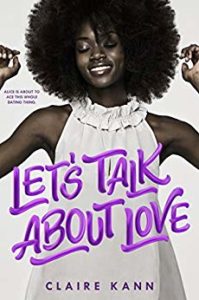
5. Alice from Claire Kann’s Let’s Talk About Love

Alice’s love of the library is what originally drew me to her. I dreamed about working at a library for a long time, and I see so many similarities between us when it comes to how we like to temporarily lose ourselves in a world of books (in a good way).

6. The Hsu, Jong, St Claire, and Woo families from Amy Tan’s The Joy Luck Club

Being an immigrant is such an interesting experience. You transition from “belonging” to one culture to feeling equally part of two (or more) of them and switching between the mindsets you develop for each one. It can be tricky to explain how this can change your perspective on life to people who haven’t been through it, but I found so many similarities between these characters and my own life.

7.  Joanna from Jaye Robin Brown’s Georgia Peaches and Other Forbidden Fruit

This is a book I’m currently reading about the queer daughter of a pastor. Not only do Joanna and I have those two things in common, we both seem to have quirky personalties as well. She seems like she’d be a great person to hang out with.

8. Jane Eyre from Charlotte Brontë’s Jane Eyre

Jane and I are honest, dignified people who love learning practical and impractical things. She also struck me as someone who was quite skilled at avoiding gossip, and I truly respect that about her. I try to act just like her when a conversation begins to turn in that direction.

9. Lily from Lisa See’s Snow Flower and the Secret Fan

Lily had such a sweet, gentle personality. She reminded me a lot of how I behave when I’m trying to make a good impression on people. Her strong creative streak also reminded me of myself.

10. Shasta from C.S. Lewis’ The Horse and His Boy

Fair warning: this book contains some language and descriptions that modern audiences would rightfully describe as xenophobic. I believe you can love a story while also acknowledging its flaws, and I’d like to think that C.S. Lewis would have written it very differently if he’d lived in our era.

With that caveat out of the way, I’ve always enjoyed the way Shasta reacted to the thought that talking horses might really exist. He was skeptical at first, of course, but he accepted it a bit faster than other people might have. I think I would have done the same thing at his age! His wary sense of adventure also reminded me of myself.

We enjoy them…but we also would be perfectly content to sit at home and eat dinner instead. Ha!

105 Comments

Filed under Blog Hops